

Remember “Liberation Day”: 2 April 2025.
The Trump administration took the U.S. economy to the edge of recession, and the world to the brink of an all-out trade war.
The market managed to reverse that, with a surge of sell-offs in the huge $28 trillion U.S. Treasury Bonds market, pushing yields on 10-year bonds as high as 4.5% on Friday 4, April, before finally, Trump backed down on tariffs.
Since then, tariffs have been on again, off again, threatened, taken away, and finally, ruled by the Supreme Court to be illegal. It doesn’t mean they won’t happen or be threatened again. But it does mean that the tariffs collected so far are illegal, and therefore, need to be repaid.
Financial Damage of Tariffs in 2025
Research from S&P Global has uncovered the true and staggering cost of US tariffs since the start of 2025: $1.2 trillion.
S&P Global’s white paper is based on “information provided by some 15,000 sell-side analysts across 9,000 companies who contribute to S&P and its proprietary research indexes.”
The analysis is sobering: “Revenue expectations have risen — but earnings expectations have fallen — producing a 64-basis-point contraction in margin. If the pattern holds for firms without sell-side coverage, the cost shock would exceed $1.2 trillion in lost profit.”
“The sources of this trillion-dollar squeeze are broad. Tariffs and trade barriers act as taxes on supply chains and divert cash to governments; logistics delays and freight costs compound the effect,” author Daniel Sandberg said to CNBC.
“Collectively, these forces represent a systemic transfer of wealth from corporate profits to workers, suppliers, governments, and infrastructure investors.”
As CNBC notes, “just one-third will be borne by companies, with the rest falling on the shoulders of consumers, under conservative estimates.”
IKEA is among the firms planning to raise prices to offset the impact of a fresh round of tariffs.
Companies have also reported more than $35bn in tariff-related costs ahead of third-quarter earnings. However, many are lowering initial forecasts, according to a separate Reuters analysis of hundreds of corporate earnings statements.
$1.2tn global supply-side and consumer costs increase
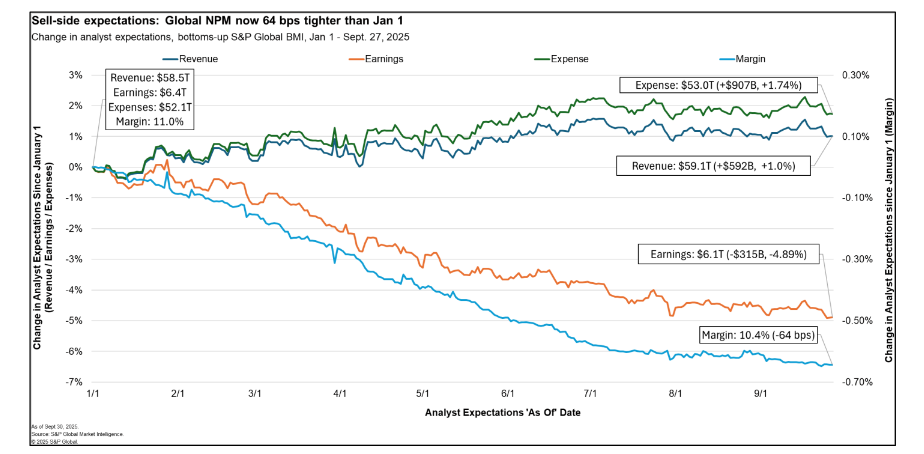
Here is a more detailed breakdown from the S&P Global Report:
- Global margin compression: A $907 billion expense shock is passed on at least two-thirds to consumers ($592bn in higher prices [for consumers]) and the remainder absorbed by companies.
- Stronger together: Margin stress spreads through supply chains. Firms with “supply chain tailwinds” (partners outperforming) were 10% less likely to see margin compression (57% vs. 67%) than firms facing headwinds.
- Closing the pressure relief valve: The de minimis rule ($800 parcel exemption) ended mid-2025, squeezing tariff-exposed sectors as shipments per container fell by half, marking a clear inflection in global trade costs.
- Tariff vs. tech tug of war: In 2025, AI lifted margins; tariffs pulled them down. Sell-side analysts rewarded balance: neutral-tone firms saw favorable margin revisions 73% of the time vs. 16% for those negative on both.
- Oh, Canada is winning 2025: Regionally, Canada (+9 bps) and China (–2 bps) held margins steady; US and Europe (–54 bps) sat mid-pack, Asia ex-China (–61 bps), MEA (–75 bps) and Latin America (–91 bps) lagged.
- The road ahead: Current belief curves imply faith in temporary shocks or successful cost mitigation, not structural decline. Margins recover from –64 bps to within 8-10 bps of Jan. 1 expectations by 2027.
Tariffs Continued in 2026
Unfortunately for the global economy, tariffs continued into 2026. Only recently, “the Trump administration issued a fresh wave of tariffs on more than 80 countries late on Thursday, ranging from 10% to 12.5%.”
We are yet to see the impact of the tariffs that have continued to be levied on global and national GDP. Nor do we know the expected impact of these latest tariffs, despite the Supreme Court ruling.
However, we can expect them to have a similar impact on global growth as in 2026. At the same time, we are now in a situation where tariffs levied in 2025 are being refunded.
💡Download our exclusive eBook: State of Trade Finance 2026 (Looking Ahead to 2027)
Impact of Tariff Refunds on Trade Finance and International Trade
Following a US Supreme Court 6-3 ruling in February 2026, tariffs are now being refunded, with 6% interest. Here is what you need to know:
- When the tariffs were imposed, they relied on using the International Emergency Economic Powers Act (IEEPA). A law that doesn’t once include the word “tariff” as a device that can be deployed against foreign powers.
- The Supreme Court has ruled that “only Congress has the power to impose taxes and duties”, making the ones imposed so far an illegal act, forcing the money to be refunded to every company that paid any tariffs.
- The amount to be refunded is “$166 billion [and] more than$85 billion has already been returned to businesses.”
The bigger question is, what does this mean for businesses that rely on trade finance, and the trade finance sector itself?
As Markus Wagner, Professor of Law and Director of the UOW Transnational Law and Policy Centre, University of Wollongong, Australia, explains in this article:
“For businesses, repaying money they should never have paid doesn’t recreate the position they were in before the tariffs.
Importers had capital tied up for months as financing costs mounted, orders were canceled, and inventory sat stranded. Many had to renegotiate contracts.
They paid customs brokers and lawyers, and delayed other investments while waiting to learn which tariff would apply. Some stopped shipping to the US altogether, unsure what customs duties they would incur.
Smaller firms were especially exposed. They generally have smaller cash reserves, fewer alternative suppliers, and less capacity to absorb an unexpected increase in duty.
One analysis estimated small business importers in the US each paid $306,000 extra in tariffs on average.
The Federal Reserve Bank of Atlanta estimates that “financially constrained” businesses will receive 34% of all refunds, or about US$56 billion. These firms are most likely to use the money to invest, hire staff or reduce prices.
Better-financed businesses are more likely to save it, repay debt or distribute it to shareholders. PepsiCo said it would use the refunds to offset some commodity inflation.”
💡For trade finance providers in particular, this money coming back is unlikely to filter upstream. However, it might mean that cash-constrained businesses (SMEs) that were affected by tariffs have a little more cash for international trade outlays in the immediate future.
As a result, SMEs that receive these refunds might have slightly less need for trade finance (SCF, IF, or working capital, etc.) in the next few months.
For some companies in countries that were affected by tariffs the first time round, they may have reduced or stopped US imports altogether. Making multi-market trade finance offerings even more important for banks in this sector. We can’t rely on the old trade routes in a market that’s being fundamentally altered.
If businesses can get the money back, it will provide a short-term boost to SMEs. For larger organizations and those providing finance, the ripples of this will barely be felt.
Do you think these tariff refunds will have much of an impact on the trade finance sector?
See what the LiquidX team has been doing recently:
LiquidX at ITFA 2026: Trade Finance Evolving And Adapting
LiquidX at GTR UK 2026: Scaling UK Digital Trade And Achieving Genuine Paperless Trade Finance
Data Transparency and the Value of Clear Data Visibility FIs & Asset Managers Can Act On
Banks and asset managers: To request a demo of our end-to-end trade finance software solutions, click here.