

In June, our largest strategic investor, Broadridge, in partnership with the Financial Times (FT), convened leaders from across the financial ecosystem at the “Accelerating Institutional Adoption of Tokenized Assets” panel.
This panel was convened to discuss the next phase of tokenized asset adoption across the financial industry and a growing number of financial institutions (FIs).
Let’s take a closer look at what this means, how tokenized assets are being used by FIs in 2026, and what’s likely to happen in the years to come.
How and Why Are Tokenized Assets Being Used by FIs?
FIs are increasingly turning to tokenization to modernize how assets are issued, traded, and settled.
Tokenized securities (which can include equities, corporate and government bonds, shares, and trade finance, like SCF, IF, and working capital) can also exist as digital tokens on a secure, private blockchain.
At the same time, real-world assets, including private credit, real estate, and commodities, can be fractionalized into smaller units that are easier to trade, opening these markets to a broader range of investors. Here’s a breakdown of the current types and uses of tokenization in FIs and the wider financial sector:
Most common types of tokenized assets
- Tokenized securities: Digital equivalents of equities, corporate and government bonds, shares, and trade finance assets, like SCF, IF, and working capital.
- Tokenized cash and deposits: Digital tokens or commercial bank liabilities that enable instantaneous on-chain clearing (24/7, thereby bypassing traditional clearing houses and timescales).
- Real-world assets (RWAs): Fractionalized units of private credit, real estate, and commodities.
4 core uses of tokenized assets in FIs
- Instantaneous settlement: Settlement involves the automatic exchange of data and value simultaneously. Removing multi-day clearing delays and reducing counterparty risk.
- Programmable compliance: Smart contracts automatically enforce transfer restrictions, corporate actions, and regulatory rules. Cutting down on manual oversight except when contracts require human-in-the-loop (HITL) authentication.
- Enhanced collateral management: With tokenization, assets move smoothly across systems, helping banks optimize liquidity and free up capital that would otherwise be trapped.
- Fractional ownership: Breaking high-value assets into smaller tradeable digital units lowers investment minimums and widens access for a larger pool of investors.
Now, with the above in mind, let’s take a closer look at what leading members of the FI community were saying at the Broadridge and FT event: “Accelerating Institutional Adoption of Tokenized Assets.”
One of the reasons this matters so much to Broadridge is its role in this tokenized asset ecosystem.
“Broadridge’s Distributed Ledger Repo (DLR) solution is the world’s largest institutional platform for settling tokenized real assets, tokenizing approximately over $365 billion a day.”
Future Thoughts on the Tokenized Asset Market
Some of the core themes that emerged from the Broadridge FT Live panel included the following:
#1: Early days for asset tokenization
Despite Broadridge operating a platform that is currently tokenizing over $365bn every day, the view is that it’s still early days for this technology.
As the CEO Tim Gokey, and Samara Cohen from BlackRock said: “The conversation is shifting from proving the technology to identifying where it can deliver measurable value – and preparing markets, infrastructure, and operating models for broader adoption.”
Implementation remains one of the biggest challenges, even for a use case that demonstrates clear value generation, like collateral mobilization.
#2: Scaling tokenization requires a minimum viable ecosystem
As Cynthia Lo Bessette from Fidelity Investments points out: “Technology alone will not drive adoption. Scaling tokenization will require the right combination of market infrastructure, liquidity, governance, service providers, and participants working together.”
“Success depends on building an ecosystem that can support adoption at scale.”
#3: Demand will determine where adoption scales first
“The most successful use cases will address real market challenges. Speakers highlighted collateral mobility, liquidity, and operational efficiency as areas where demand is already emerging.”
“Long-term adoption will depend on delivering meaningful benefits to investors and institutions.”
#4: The future is hybrid
It’s unlikely that FIs will go 100% tokenized or ledger-based for any particular asset class or financial vehicle.
But at the same time, “the opportunity lies in linking trusted market infrastructure with new digital rails while preserving the governance, compliance, and investor protections that markets depend on.”
Wider Industry Views on Tokenized Assets
Following the panel, they released an inaugural Broadridge Tokenization Pulse Survey, and these were some of the main findings:
- 84% of firms say tokenization is strategically important to their organization.
- 68% believe tokenization will partially reshape financial markets within the next three to five years.
- 69% plan to hybridize existing infrastructure rather than build fully separate systems.
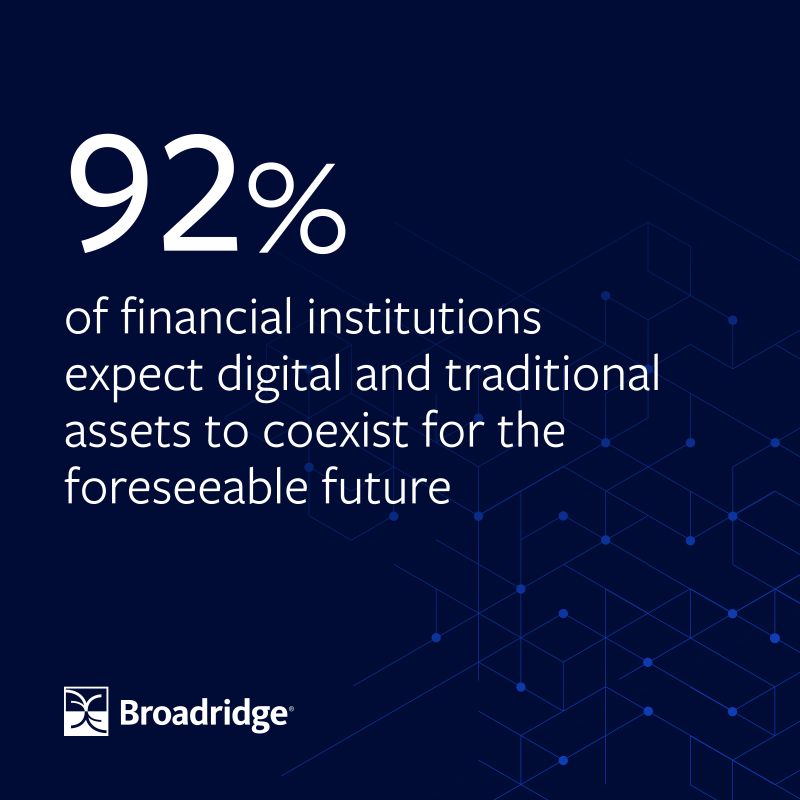
- 92% expect digital and traditional assets to coexist for the foreseeable future.
- Nearly one-third plan to increase tokenization investment by 26% to 50% or more over the next two years.
Methodology
Broadridge commissioned Phronesis Partners to conduct this survey. The study surveyed 200 senior decision-makers across wealth management, asset management, capital markets, and digital asset firms in the United States and Canada.
In response to the survey results, German Soto Sanchez and Mark Nichols, Co-Presidents of Digital Assets at Broadridge, said:
“Across the industry, there is clear recognition that tokenization has the potential to reshape how assets are issued, traded, financed, and serviced.”
“These survey results underscore both the opportunities and challenges firms face as they seek to connect digital and traditional assets, support governance and controls, and build markets that are efficient, resilient, and trusted.”
Download the full report and explore all findings here.
What do you think: Will FIs and the wider sector benefit from increased tokenization?
Can FIs invest in tokenization at the same time as AI integration and adoption?
Questions for all of us to think about.
💡Download our exclusive eBook: State of Trade Finance 2026 (Looking Ahead to 2027)

See what the LiquidX team has been publishing recently:
How Do Tariff Refunds Impact the Trade Finance Sector?
State of the Letters of Credit (LC) market in 2026
How Can Banks, FIs & Asset Managers Perform Due Diligence on AI Products, Tools, and Integrations?
Data Transparency and the Value of Clear Data Visibility FIs & Asset Managers Can Act On
Banks and asset managers: To request a demo of our end-to-end trade finance software solutions, click here.