

In a GTR article on the topic of banks reducing the speed of digital trade finance adoption, Vinay Mendonca, head of trade and supply chain finance product at software provider Finastra, says, “I don’t see a slowdown in digitization because with the scaling of AI, we see a lot of demand from banks to unlock the benefits from it.”
“But you’re not going to get these AI benefits if you’re still dealing with physically handwritten bills of lading with most of the data still locked in.”
And he would be right.
We expand on this topic in a recent article on digital bills of exchange and bridging the $2.5 trillion trade finance gap for SMEs.
But that GTR article wasn’t just talking about AI and one specific type of trade finance product, vehicle, or company.
In the GTR article, Jacob Atkins, a GTR journalist claims that: “trade finance remains stuck taking baby steps towards digitalisation”, and that banks, in particular, are “scarred by startup shut-downs and lukewarm client appetite, are now taking a much more cautious approach.”
At the crux of the argument is that between 2015 and 2020, when the pandemic gripped the world, “it was a boom time.” This “euphoric phase” continued despite Covid-19, but then fizzled out around 2022/23, according to Atkins.
Key Takeaways (TL;DR): Are banks slowing down trade finance adoption?
- In our experience, no, that isn’t happening.
- Growth from banking, SaaS, and asset management customers accelerated in 2025 and has continued in 2026. We see no sign of this changing in the mid- to long-term.
- One reason is ongoing innovation in this space, including the need to integrate AI and ML tools and solutions on a client-by-client basis.
- The other reason is that trade finance is not limited to banks and corporate clients. Other players, including asset managers, SMEs, non-bank and neo-bank lenders, and institutional investors, all play a role in this dynamic market.
- Any slowdown in this market that the GTR article references can be more easily explained in a number of ways:
- The financial sector is known for taking time and being cautious when it comes to new technology. It can take a few months or quarters to onboard a new bank, even when they’ve got an ecosystem of SaaS vendors within their trade finance program.
- It can take several months after a proof of concept or trial period to fully integrate, scale, and demonstrate ROI.
- As a result, technology adoption and integration run on their own timescale, which differs depending on the bank(s) in question.
- Other players in this ecosystem, like asset managers and SaaS partners, can and do move quicker. But many prefer white-label or NDA-based partnerships, so vendors like ourselves who are having success in these verticals can’t always shout about these ongoing wins.
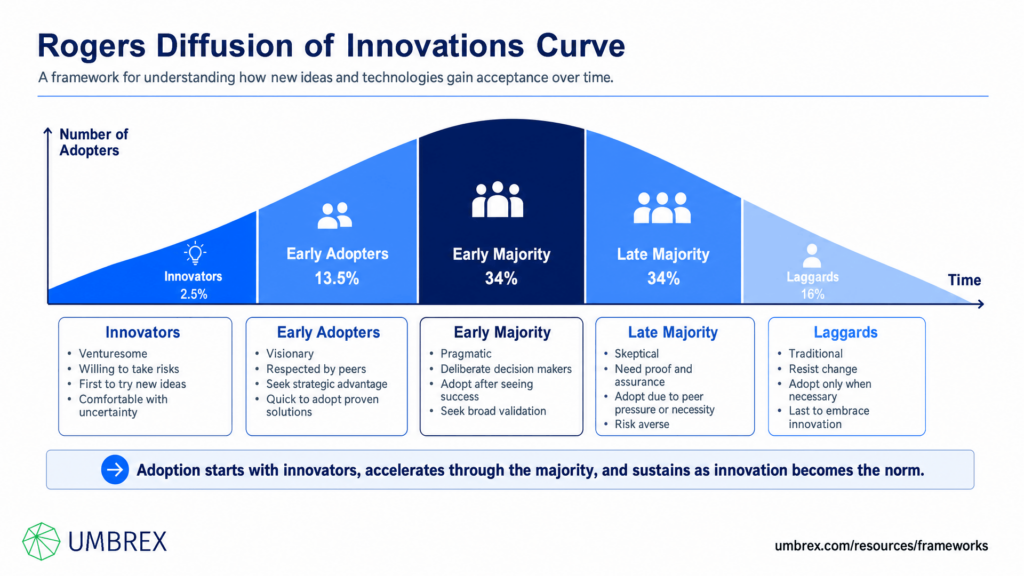
A lot of what we are seeing — like the post-pandemic platform clearout — is the Rogers diffusion of innovation curve in action. This is a natural part of market adoption, and Moore’s Crossing the Chasm explained it further for the tech sector.
Let’s dive into all of this in more detail.
Progress on Trade Finance Digitalization is Continuing at a Steady Pace
Atkins isn’t wrong in acknowledging the “post-pandemic platform clear-out”, resulting in the collapse or shuttering of several fintechs, including Raistone, Stenn, Serai (a wholly-owned HSBC subsidiary), and others.
He’s also right about the caution some banks are taking beyond the proof-of-concept and pilot phases.
At the same time, the author accepts that “progress on digitalization is continuing”, especially when it comes to “how eBLs and other digital documents can be incorporated into financing structures.”
This also includes the impact of MLETR-style legislation, bills of lading, and letters of credit. All key trade finance instruments. The article mentions major global banks, including Citi, JP Morgan, and Lloyds Bank (UK) are continuing to make progress on trade finance digitisation.
SaaS Trade Finance Platforms Remain an Essential Part of the Ecosystem
The article also mentions a range of the most well-known trade finance SaaS providers, and it confirms that “some platforms have been around for many years, and there is no suggestion they are financially unsound.”
Considering the disruption in the private credit market, and the occasional misunderstanding that this reflects on trade finance, it’s useful that the GTR journalist is clear on that point.
Dominic Capolongo, our chief revenue officer (CRO), told GTR that asset managers are facing questions from wary investors “who are lumping working capital and private credit together”.
As a result, managers “are having to slow down origination of working capital, and are trying to educate investors on why it has a totally different risk profile”, he says.
That’s the main issue here: Investors are linking disruption in private credit with trade finance.
“We’re seeing a lot of asset managers realizing that if they had a more diversified approach and more short-term working capital, they would be in better shape and wouldn’t have to slam down the gates.”
Now, with the above in mind, we have to ask a couple of questions:
- Why does the article limit its analysis of trade finance to banks and corporates?
- And could the analysis be explained simply as the Rogers Diffusion of Innovation Curve in action?
Let’s start with the last one first.
Rogers Diffusion of Innovation Curve in Action for Trade Finance?
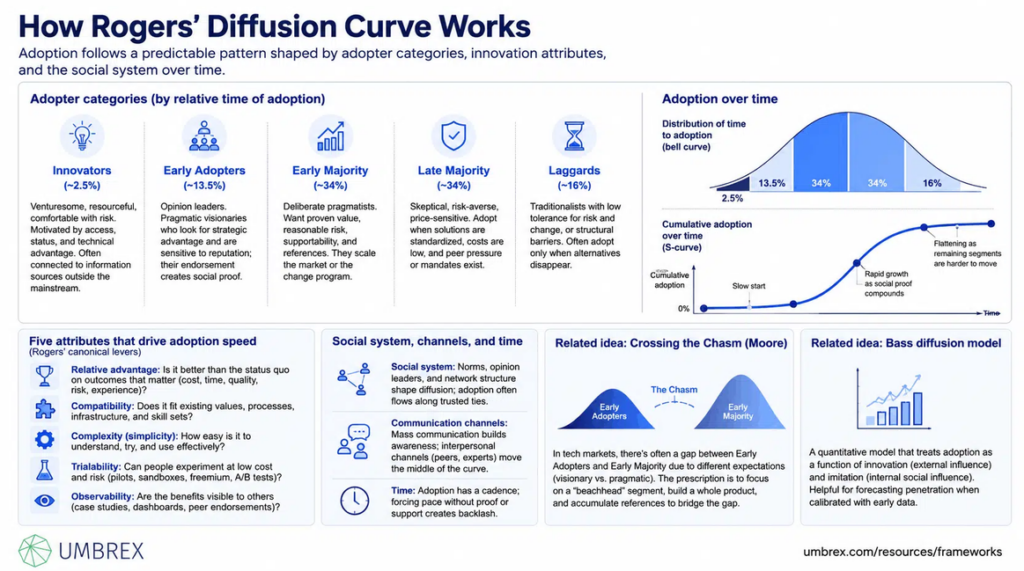
In 1962, Everett M. Rogers published Diffusion of Innovations (multiple updates since then), and in it, he showed that the adoption of anything new “is a social process, not just a rational one: perceived advantage, compatibility with norms, simplicity, ability to try, and visible results matter.”
Rogers then went on to include “quantitative diffusion (e.g., the Bass model).”
Looking at the technology sector more closely, Geoffrey Moore’s Crossing the Chasm (1991, revised 1999 and 2014) clarified how and why people and companies gradually adopt and adapt to new technologies.
Rogers focused on how “innovations spread in agriculture, public health, and communities,” whereas Moore took those concepts and applied them specifically to technology.
Even a basic application of Moore’s theory on the adoption of AI would tell us that we are currently in “the chasm.” Adoption, and the benefits from using AI, aren’t anywhere close to the aspirations and goals of the AI giants.
The trade finance market, especially when we factor in every type of financial vehicle and vertical, like cross-border inventory finance (IF), is large and established.
Recent research shows the trade finance market remains sizable, with projected revenue growth from $52 billion in 2024 to $68 billion in 2030. Meanwhile, the even larger IF market is expected to grow from $205B in 2023 to $558B in 2033.
In neither scenario could we say that trade finance software is in the early adopter stage. At best, we could say we are in a shallow chasm driven by a mix of choice paralysis, overabundance of caution, and AI-connected fatigue.
The AI connection is that banks are being encouraged to integrate AI into numerous software solutions but are unclear on the specifics. This is affecting the adoption of almost every type of technology and increasing onboarding and integration timescales.
Looking at the adopter categories from Rogers’, this is exactly what the majority of decision-makers look like: “Early Majority (~34%): Deliberate pragmatists. Want proven value, reasonable risk, supportability, and references. They scale the market or the change program.”
In that case, this perceived slowdown is entirely normal, even expected. Especially in the context of an AI boom happening at the same time, and how AI is impacting how banks and asset managers adopt and adapt to digital trade finance software and programs.

Trade Finance Isn’t Limited to Corporates and Banks
The trade finance sector has never been limited to corporates and banks, yet those are the only players the author of the GTR article interviews.
In our experience, asset managers and SaaS partners play an equally important role.
Including fiscal year 2025 and H1 2026, our technology has processed over $134 billion in trade finance transactions for global and regional banks and asset managers.
LiquidX’s total annual trade volumes reached $27.2 billion in 2025, up from $25.1 billion in 2024, representing an 8% year-over-year increase. Momentum accelerated in the first half of 2025, with volumes rising 14% year over year, pointing to continued growth despite broader market volatility.
Asset managers now account for approximately 26% of total trade finance volume, up significantly from their share in 2021.
We are pleased to report that, so far in H1 2026, $14.3 billion has been processed, showing continued growth of over 12% compared to H1 2025. And that’s despite numerous economic headwinds against the trade finance sector.
This steady increase in asset manager volume reflects growing institutional confidence in trade finance as a source of diversified yield, supported by short durations, self-liquidating structures, and improving data transparency. LiquidX anticipates this trend to extend globally.
“As asset managers, working capital finance offers short-duration, low-volatility exposure with attractive diversification,” said Guy Brooks, Managing Director, Working Capital Finance, Pemberton Asset Management.
“With working capital finance, typical maturities range from 90 to 180 days, with annualized returns between 2% and 5%+ over base, and historic market data showing default rates below 0.5%. This makes it a compelling alternative to traditional fixed income, especially in volatile or rising-rate environments.”
What’s Changing With LiquidX in 2026?
LiquidX is moving more into pure business operating tech and transaction management. From now on, our focus is on supporting global and regional banks, asset managers, and FinTech SaaS (usually via a white-label model).
Over the years, the market has evolved. Other providers have entered, consolidated, or exited.
Our key strategic shift in 2026 is moving to a purely product-centric approach.
Unlike other providers that still operate on a transaction-based model and sometimes appear to compete with the FIs they serve, we provide technology at scale to our global and regional partners.

Recap: Are banks slowing down trade finance adoption?
In our experience, banks aren’t reducing or slowing down trade finance digital technology adoption.
Growth from banking, SaaS, and asset management customers accelerated in 2025 and has continued in 2026. We see no sign of this changing in the mid- to long-term.
- One reason is ongoing innovation in this space, including the need to integrate AI and ML tools and solutions on a client-by-client basis.
- Other players, including asset managers, SMEs, non-bank and neo-bank lenders, and institutional investors, all play a role in this dynamic market.
- Any slowdown in this market that the GTR article references can be more easily explained in a number of ways:
- The financial sector is known for moving slowly and being cautious with new technology. It can take a few months or quarters to onboard a new bank, even when they’ve got an ecosystem of SaaS vendors within their trade finance program.
- It can take several months after a proof of concept or trial period to fully integrate, scale, and demonstrate ROI.
- As a result, technology adoption and integration run on their own timescale, which differs depending on the bank(s) in question.
- Other players in this ecosystem, like asset managers and SaaS partners, can and do move quicker. But many prefer white-label or NDA-based partnerships, so vendors like ourselves who are having success in these verticals can’t always shout about these ongoing wins.
A lot of what we are seeing is the Rogers diffusion of innovation curve in action. Moore’s Crossing the Chasm explained this further for the tech sector, and when you mix the needs of the financial sector with choice fatigue, growth can appear to slow.
We can only assure our customers, partners, and investors that this is not the case for LiquidX. Growth continues at the same steady upward pace as in recent years.
See what the LiquidX team has been doing recently:
LiquidX at ITFA 2026: Trade Finance Evolving And Adapting
LiquidX at GTR UK 2026: Scaling UK Digital Trade And Achieving Genuine Paperless Trade Finance
Data Transparency and the Value of Clear Data Visibility FIs & Asset Managers Can Act On
Banks and asset managers: To request a demo of our end-to-end trade finance software solutions, click here.