
For banks and asset managers, their data is highly proprietary and confidential. The data that flows through any trade finance and private credit system is a core part of that organization’s IP.
Trade finance program managers have never needed data transparency and visibility more than they do now.
Data overload, more stringent compliance requirements, Basel III, and AI are all driving the need to find a solution to the universal challenge of unclear and opaque data pipelines and warehouses.
One consequence of that is we have been busy (for over 2 years) working on a significant update to our TradeHub solution.
Once it’s ready to launch, we will roll out TradeHub 2.0, which will include:
- Enhanced and completely customizable data views, aggregations, and consolidations.
- The ability to monitor risk at the portfolio level.
- A 1-click decision tool: Want to distribute, or decrease portfolio risk? You’ll be able to do that from a massively enhanced dashboard.
- Other self-serve tools, solutions, and a lot more coming for every customer in 2026 and 2027.

What is TradeHub?
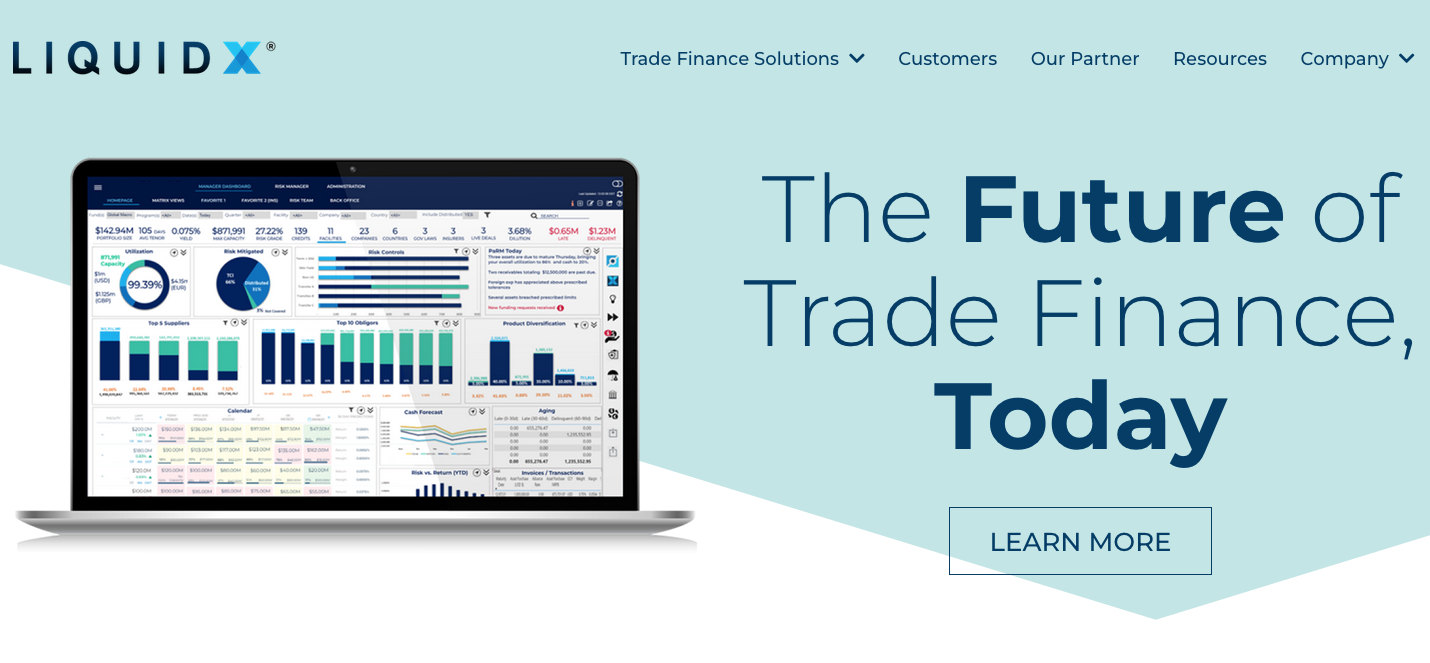
TradeHub is the first complete, platform-agnostic, real-time, middle-office digital solution for all your positions and transactions.
Aggregate positions from various banks and platforms in a real-time dashboard.
TradeHub allows customers to aggregate their data across various investment programs and platforms, regardless of the origination source.
Create holistic views of your exposures relative to your unique risk constraints. The automation of reconciliation processes allows our engine to digitally match invoices, remittance advice, and payments.
TradeHub is fully configurable to your requirements with bespoke cross sections for your business. Data is accessible to stakeholders across your institution in order to make real-time, data-driven decisions.
You can set up customized feeds and reports for unprecedented insights into your portfolios.

TradeHub Case Study: Huntington Bank
About Huntington Bank
Huntington Bank is a $285 billion asset regional bank headquartered in Columbus, Ohio. Founded in 1866, Huntington now operates over 1,400 branches in 21 states, with certain businesses operating in extended geographies.
The bank and its affiliates provide consumers, small and middle‐market businesses, corporations, municipalities, and other organizations with a comprehensive suite of banking, payments, wealth management, and risk management products and services.
As part of these services, Huntington has a trade finance program with multiple financial flows to and from dozens of banks, SMEs, trade finance lenders, and corporates.
The challenge:
Huntington Bank needed to automate back-office constraints that came with managing program participation from multiple banks.
Huntington was managing a complex multi-billion-dollar trade finance program using spreadsheets. As many banks, corporate treasuries, and asset managers still do.
They started using software on a small-scale to give them better oversight, but they still weren’t getting the real-time visibility the program and senior leaders needed.
A dashboard was becoming essential. Especially as they wanted to go from participating to originating deals. The risks of being an originating financial institution (FI) without a dashboard, without clear visibility, were becoming obvious.
Program managers at Huntington were encouraged to talk to us, and so we came in with a solution for the challenges they were having.
The solution:
The LiquidX platform digitized all reports to standardize detail, configurable reporting, and automated invoice reconciliation. This removed back office constraints to significantly increase the number of programs originated and participated.
Now, Huntington Bank has a single source of truth, a reliable overview dashboard containing multiple data streams.
Real-time visibility de-risks trade finance, providing information that program managers can act on, whether they’re originating, distributing, or simply participating.
Alongside that, the visibility makes it much easier for Huntington to become a distributing bank. Trade finance distribution is usually done on an “originate-to-distribute” (OTD) model to ensure an originator isn’t inadvertently holding onto too much trade finance exposure on their balance sheets.
Distribution is an increasingly popular alternative asset because it unlocks opportunities and growth revenue for every party in the transaction.

Now, let’s turn our attention to the iteration we’ve been working hard to deliver: TradeHub 2.0.
What is TradeHub 2.0, and Why Banks & Asset Managers Need it for Trade Finance Programs?
TradeHub 2.0 is the result of over 2-years of iterative R&D work and investment.
It’s the result of listening to our customers, understanding their needs and pain points, and identifying ways to improve on our core TradeHub solution.
One reason this is so important is that data is the IP of any financial organization with a trade finance program. Keeping that data secure while ensuring your team and any counterparty can access the right data when needed is crucial.
With TradeHub 2.0, trade finance programs will benefit from:
- A consolidated single source of truth for trade finance data, deals, and funding flows.
- The ability to filter that data through the lens of what matters most: Performance, speed, risk factors, and revenue-generating upsides
- The ability to handle large (very large) data sets, including entire data warehouses, with ease.
- Viewing temporal and historical data, with time-based filters and toggles for what you are looking and searching for.
- Risk monitoring at the portfolio level.
- A pragmatic approach to how AI is used and integrated. We keep everything compliant and don’t let any AI models and tools near your data.
- A 1-click decision-making solution. Need to sell part of your portfolio (de-leverage or simply distribute)? You’ll be able to do that within the TradeHub 2.0 dashboard.
- A true self-serve solution. You will be able to do everything in-house without increasing headcounts or budget.
All of this means that you can manage your trade finance portfolio far more easily than you can now. With much greater visibility and enhanced risk management.
We will have more information about this once TradeHub 2.0 is ready to launch.
Banks and asset managers: Would you benefit from TradeHub? Contact us today for a Demo.