
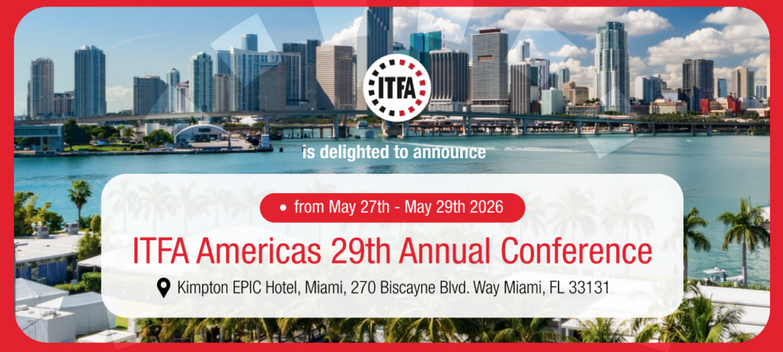
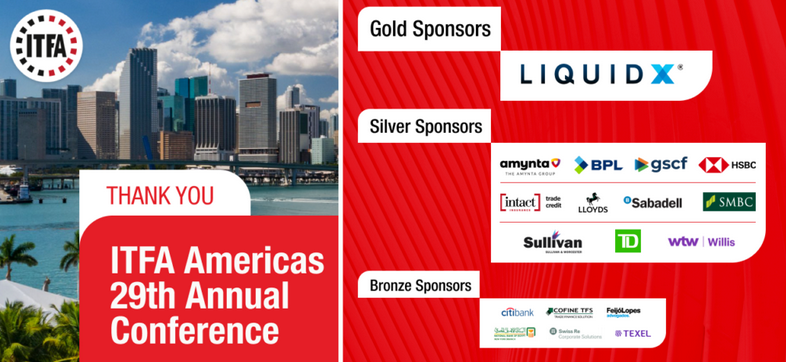
Miami, Florida, 27 – 29 May, 2026 ⏤ LiquidX was delighted to attend and be a gold sponsor for the 2026 ITFA Americas 29th Annual Conference.
The ITFA Americas Annual Conference is a cornerstone of the ITFA event calendar, and the 2026 edition promises to be no exception. ITFA has an exciting and comprehensive agenda that includes educational workshops and more than a dozen panel sessions.
These explored key themes including:
- The geopolitical impact of current events on trade finance
- Global economic outlook
- Commodities and supply chain finance
- Digitalization and AI
- Preventing fraud
- Evolving regulatory landscape.
Like last year, we were glad to attend, be a sponsor, and network with other players in the wider trade finance community and ecosystem. Danielle Vitagliano attended on behalf of the LiquidX team.
Let’s explore some of those core themes further here:
Digitalization, AI, and Preventing Fraud in Trade Finance
Trade finance and private credit suffered a few shockwaves towards the end of 2025 (First Brands Group (FBG), Tricolor, and Cantor Group), and we’re still feeling those shockwaves in 2026.
Alongside that, KYC, AML, and fraud prevention are more important now than ever.
“An estimated $1 trillion of financial crime proceeds flow through the $9.1 trillion industry’s trade channels each year”, according to an EY article.
That article goes onto say that: “On average, a large trade finance bank can spend anywhere from $25m to $42m annually on risk, compliance, sanctions and anti-money laundering (AML) tasks – all without growing its business.”
As we’ve found, the way forward means that:
Periodic KYC is no longer fit for purpose. Periodic, calendar-based reviews cannot keep pace with the rapid evolution of counterparty risk. There have been too many high-profile compliance and KYC failures to justify the risk of continuing to use tech that isn’t fit for purpose.
Perpetual KYC (pKYC) is the way forward. A continuous, event-driven approach — tightly integrating onboarding, sanctions screening, transaction monitoring, and case management — gives banks, asset managers, and corporate treasuries a real-time picture of counterparty risk and a defensible audit trail.
Alongside changes to KYC and AML, there’s always the question of AI in trade finance.

What Role Should AI Play in Trade Finance?
Joon Kim, global head of trade finance and cash management platform at BNY, said: “If you do not have an AI initiative at your respective organizations, and do not have a use case, I think that’s sort of like… a red flag” (BAFT GAM, Florida, May 2026: GTR).
Industry leaders like Broadridge report 80% of firms globally are making moderate to large AI investments, signaling a decisive shift in the competitive landscape (our key strategic partner).
As we’ve found, the key challenge is always the practical, effective implementation tailored to meet client needs, and this is a different conversation for every service provider and FI.
In our GTR survey, participants said that AI, automation, and digital platforms are seen as the primary drivers of transformation.
AI adoption is underway. However, for many reasons, this isn’t universal. 50% are already using AI/ML tools.
The other 50% are not yet using AI, but many are considering it. Across the board, FIs are stepping up their due diligence on AI applications to ensure reliability, security, and compliance. AI usage appears stronger among larger or digitally focused institutions.
Read more about our evolving approach to AI and machine learning (ML) in these articles:
How Can We Realize AI’s Potential To Generate Value in Trade Finance
AI & ML in Trade Finance: From Buzzword to Back Office Reality
The advantages of a platform and document-agnostic trade finance solution
How AI is Changing Trade Finance Risk Management

The Advantages of Being Platform & Data Agnostic
Compared with other financial asset classes, trade finance remains too heavily reliant on email, paper, and even fax.
Banks, corporates, and even some asset managers continue to rely on old methods and outdated in-house or custom-built software, risking being left behind.
Back-office staff at banks, asset management firms, and businesses that originate and receive supply chain finance usually need to painstakingly review documents, rekey information from PDFs, and reconcile payments to invoices using spreadsheet-based tracking.
Some of the challenges of sticking to outdated manual processes include the following:
- Too time-consuming
- Resource intensive
- Errors happen
- Compliance failures
The only way to implement trade finance successfully, without scaling headcount and costs, is to partner with a provider who can handle everything for your trade finance program.
LiquidX’s suite of trade finance solutions can handle everything, with a smooth-running turnkey front-, middle- and back-office operation that manages the entire origination-to-reconciliation lifecycle.
Here’s what you can benefit from when you partner with LiquidX:
- Trade finance software that can take in any invoice format (e.g., XLSX, PDF, etc.), and use that as workable data downstream across the trade lifecycle.
- Automatically digitizes assets in the front office (Trade).
- Manages portfolio risk with TradeHub.
- Make significant back office savings (TradeOps); up to 50% savings compared to in-house back office software.
- Can handle reconciliation challenges for global and regional banks (InMatch module).
- Includes the advantages of a deep partnership with Broadridge (NYSE: BR), a trusted global fintech leader. Broadridge is LiquidX’s largest committed investor and strategic operational services provider for payment processing, account reconciliation, and global operational scalability.
Banks and asset managers: To request a demo of our end-to-end trade finance software solutions, click here.