
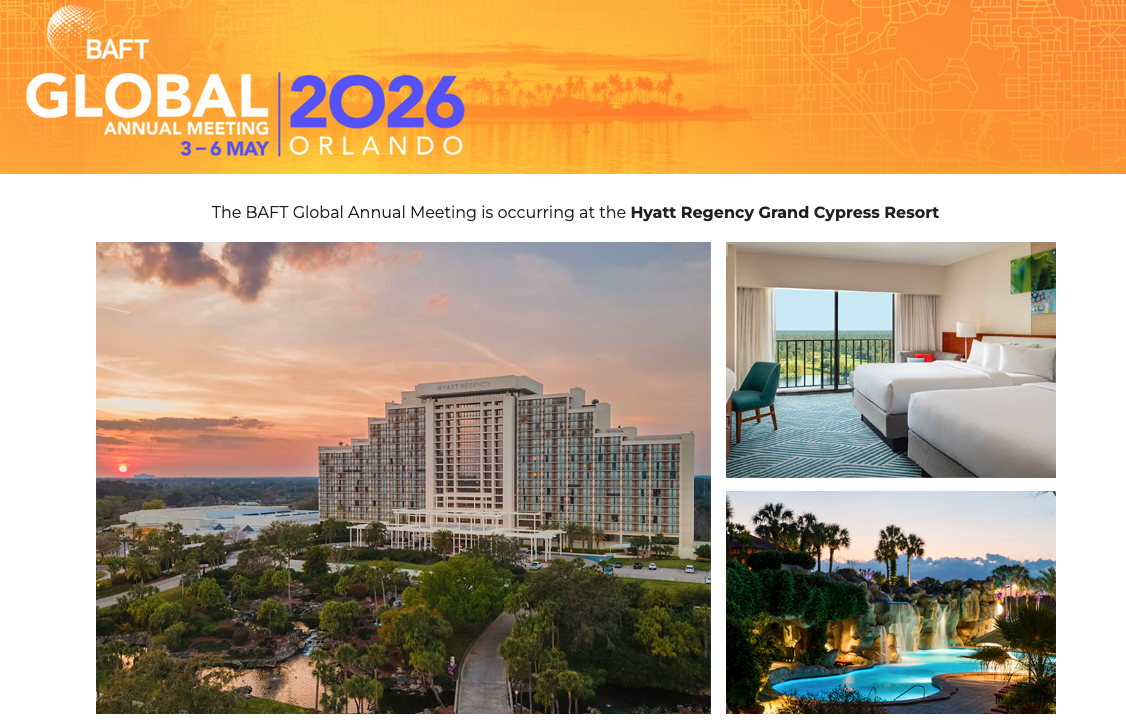
Orlando, Florida, May 3 ⏤ 6, 2026 ⏤ LiquidX was delighted to attend and be a gold sponsor for the 2026 Bankers Association for Finance and Trade (BAFT) Global Annual Meeting (GAM).
The theme this year is: Global Realignment: New Opportunities for the Future of Transaction Banking
With shifting trade corridors, evolving geopolitics, and accelerating digital innovation, the transaction banking industry is redefining its role in a changing world.
As traditional models are challenged and new ecosystems emerge, financial institutions are rethinking strategies across payments, trade, liquidity, and risk to stay competitive and relevant.
This year’s conference theme highlights the opportunity to harness innovation, strengthen collaboration, and unlock new growth pathways that will shape the next era of transaction banking.
BAFT brings together the brightest minds and key players in global transaction banking, trade finance, and fintech.
As a leading provider of trade finance technology solutions, we are proud to be a part of this gathering, where we’ll engage with industry leaders, share insights, and explore innovative strategies to drive growth and efficiency.
Trade Finance in Transition
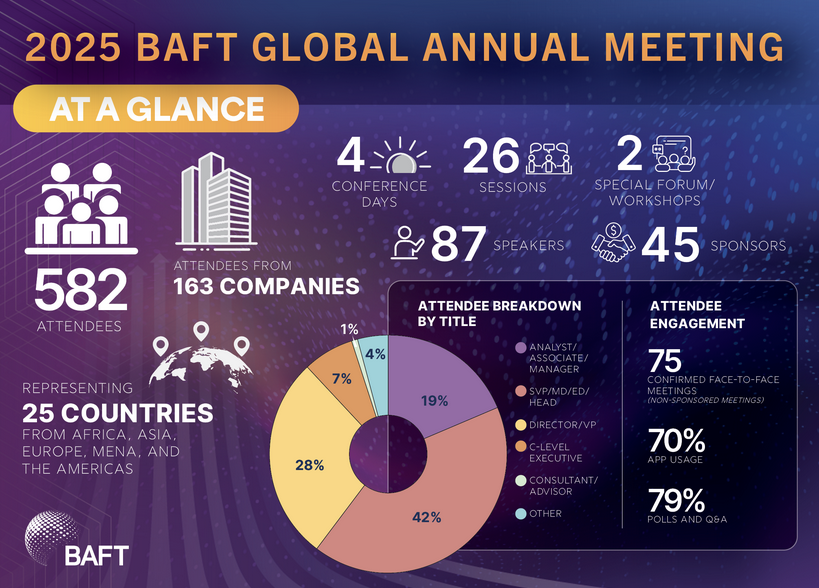
Our CRO, Dominic Capolongo, no stranger to trade finance conversations at the highest levels, sat on the panel, “Trade Finance in Transition.”
Global trade finance is at an inflection point. This panel examined the forces reshaping the industry, including:
- Digital legal reforms
- Evolving regulatory frameworks
- Fundamental shifts in how supply chain finance is structured and delivered
- How working capital models are adapting to new market realities
- How multilateral and development institutions are filling critical financing gaps
- Where innovations in trade credit insurance and risk distribution are opening new possibilities for banks and their clients.
Dominic was on the panel with Mariya George (CEO, Cleareye.ai), Anubhav Shrivastava (North America Trade and Working Capital Head, J.P. Morgan), and Michael Babbitt (SVP, Head of Trade and SCF Sales, Synovus), as moderator.
From LiquidX, Kevin O’Connor (Director, Head of Client Services), and Sophie McArdle (Client Solutions Associate) also attended BAFT.
If you want to watch the panel, BAFT recorded and posted it to YouTube.
How is Trade Finance Changing in 2026?
Global trade finance is undergoing its most significant transformation in decades. This gradual, iterative transformation is being driven by numerous converging pressures — regulatory reform, AI-driven disruption, and structural shifts in the world economy.
Our sector is moving from legacy paper-based processes to a more agile, AI-powered, digital-native framework.
At the legislative level, the adoption of digital legal frameworks, including the Model Law on Electronic Transferable Records (MLETR), is finally gaining meaningful traction. First proposed in 2017, the use of electronic bills of lading and digital trade documents is being recognized as legally binding by more countries than ever.
Combined with AI adoption, all of this is unlocking efficiencies that were previously impossible. This fundamentally rewires how financial and trade instruments are created, transferred, and settled.
Regulatory evolution is also keeping pace. Frameworks governing capital treatment of trade assets, anti-money laundering requirements (AML and pKYC), and cross-border data flows are aligning with more complex trade finance transactions. Banks are adapting compliance infrastructure accordingly, balancing risk management with the need to remain competitive.
Supply chain finance (SCF) is being restructured. Working capital models are evolving as corporates demand greater flexibility, and as fintech platforms challenge traditional bank intermediation. The result is an ecosystem where non-bank lenders, insurers, and technology providers each play an increasingly important role.
Multilateral development banks and export credit agencies are stepping in where private capital remains cautious, particularly in emerging markets where the trade finance gap continues to widen.
At the same time, trade credit insurance is becoming a more dynamic tool. Improved data, better risk modeling, and greater appetite for risk distribution are enabling banks to extend credit to clients and corridors previously considered too risky.
Amid all the talk of change, we return to our regular theme: AI.
One Unavoidable Takeaway: ‘If you don’t have an AI initiative… that’s a red flag’
“Joon Kim, global head of trade finance and cash management platform at BNY, said banks without clear AI strategies risk falling behind competitors already embedding automation into trade operations.
“If you do not have an AI initiative at your respective organizations and do not have a use case, I think that’s sort of like… a red flag,” Kim said at the May 3-6 event. “AI is going to be a fundamental element that’s going to drive our business so that we can build the scale and do more trade transactions for our clients.”
Kim argued AI is already proving valuable across operational areas such as document processing and transaction execution, particularly within a business that remains “very manual” and paper-heavy.
“Trade finance is really about how do we process these transactions as quickly as we can so that the importers and exporters do not think of letters of credit or standby or supply chain financing as a means for banks to just delay payments, not providing the financing,” he said.”
Continue reading about that here.
We will soon be publishing our State of Trade Finance 2026 eBook, and that includes what GTR members are thinking and saying about where they are with AI initiatives in their organizations.
Trade finance program managers have never needed data transparency and visibility as they do now.
Data overload, more stringent compliance requirements, Basel III, and AI are driving the need for a solution to the universal challenge of opaque, unclear data pipelines and warehouses.
One consequence of that is we have been busy (for over 2 years) working on a significant update to our TradeHub solution.

TradeHub 2.0 For Banks & Asset Managers
TradeHub 2.0 is in the works, and will be the result of listening to our customers, understanding their needs and pain points, and identifying ways to improve our core TradeHub solution.
One reason this is so important is that data is the IP of any financial organization with a trade finance program. Keeping that data secure while ensuring your team and any counterparty can access the right data when needed is crucial.
When it launches, trade finance programs will benefit from:
- A consolidated single source of truth for trade finance data, deals, and funding flows
- The ability to filter that data through the lens of what matters most: Performance, speed, risk factors, and revenue-generating upsides
- The ability to handle large (very large) data sets, including entire data warehouses, with ease
- Viewing temporal and historical data, with time-based filters and toggles for what you are looking for and searching for
- Risk monitoring at the portfolio level
- A pragmatic approach to how AI is used and integrated. We keep everything compliant and don’t let any AI models and tools near your data
- A 1-click decision-making solution. Need to sell part of your portfolio (de-leverage or simply distribute)? Or want to get insurance for some or all of your trade finance portfolio? When it launches, you’ll be able to do that within the TradeHub 2.0 dashboard
- A true self-serve solution. You can do everything in-house without increasing headcounts or budgets.
All of this means that you can manage your trade finance portfolio far more easily than you can now. With much greater visibility and enhanced risk management.
Banks and asset managers: To request a demo of our trade finance distribution solutions, click here.