
Key Takeaway: In this article, we ask how FinTechs help clients and partners become more transparent, robust, and secure?
The US and global economy has gone through unprecedented turbulence since the start of 2025.
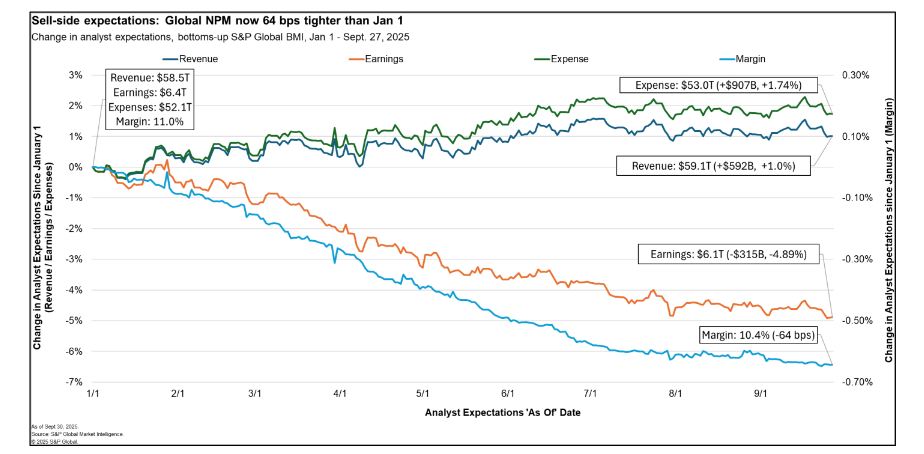
In particular, since “Liberation Day” the true and staggering cost of US tariffs now stands at $1.2 trillion, according to S&P Global’s recent white paper.
The analysis, based on 15,000 sell-side analysts across 9,000 companies, shows that: “Revenue expectations have risen — but earnings expectations have fallen — producing a 64-basis-point contraction in margin. If the pattern holds for firms without sell-side coverage, the cost shock would exceed $1.2 trillion in lost profit.”
As CNBC points out, “just one-third will be borne by companies, with the rest falling on the shoulders of consumers, under conservative estimates.”
Hundreds of publicly-listed businesses have also reported more than $35bn in tariff-related costs ahead of third-quarter earnings, according to a separate Reuters analysis of hundreds of corporate statements.
S&P Global analysis of US tariffs: $1.2tn global supply side and consumer costs increase
This is the current macroeconomic reality we are operating in.
According to the IMF’s latest World Economic Outlook (WEO), global economic growth is expected to be 3.3% in 2025, and “3.1 percent in 2026, with advanced economies growing around 1.5 percent and emerging market and developing economies just above 4 percent.”
When it comes to trade finance, we’ve analyzed our own data since 2021.
Including the first 6 months of 2025 (H1), we’ve processed over $76.5 billion in trade finance transactions, with total volumes up 431% in 4 years.
Based on our mid-year data analysis, we’ve not seen any slowdown from any sector or market segment.
However, the economy can still negatively impact and even wipe out organizations in the trade finance sector. So, the question is: How can FinTechs help clients and partners become more transparent, robust, and tech-centric?
How FinTech SaaS Businesses Can Help Clients & Partners Become More Transparent, Robust, and Secure
When we think about helping financial institutions, corporate treasuries, and asset managers become more transparent, robust, and secure, it means:
- Reduce Risks With AI-Powered Analysis
Use AI-powered risk management analysis to predict counterparty risk, detect fraud, and optimize distribution strategies.
Risk management and compliance can be an expensive ⏤ but regulatory and operationally crucial ⏤ part of trade finance.
An EY article notes that: “On average, a large trade finance bank can spend anywhere from $25m to $42m annually on risk, compliance, sanctions and anti-money laundering (AML) tasks – all without growing its business.”
AI and digital tools with automation embedded into them can dramatically reduce the need for manual work, and the cost of risk management in trade finance.
- Use AI for Fraud Detection, Prevention
According to EY, “An estimated $1 trillion of financial crime proceeds flow through the $9.1 trillion industry’s trade channels each year.”
As a result, KYC and AML are an essential part of any trade finance transaction.
As part of risk management, if you automate and use AI for the usual fraud detection checks and safeguards it makes this process easier, more efficient, faster, and less prone to human error.
- Predictive Analytics and Forecasting
Banks and asset managers need a way to forecast demand, assess who’d be a good buyer for trade finance assets at spread, and reduce counterparty risk and being overexposed to any one organization, sector, or transaction type.
For example, if you are holding $500M in a $1bn portfolio of short-term consumer goods transactions, it might be worth diversifying your portfolio.
It should also be easier to see which parties you’ve sold or bought from, preventing accidentally selling any financial tranches twice.
AI analysis can help make this easier, with automated alerts and rebalancing trigger points.
- Faster, Digital Document Processing
On the supply-side, trade finance transactions involve processing invoices, certificates of origin, and customs documents.
AI-driven optical character recognition (OCR) and natural language processing (NLP) accelerate document review and extraction, dramatically reducing turnaround times.
All of this makes digitization, which is the first stage in any trade finance transaction, including monetization.
- Deeper Market and Trade Finance Insights
AI can aggregate and analyze global trade flows, pricing trends, and regulatory changes. This gives trade finance teams valuable insights into emerging opportunities and risks.
These analytics support smarter portfolio diversification strategies and can help spot opportunities when they emerge.
- AI for Pattern Recognition & More Robust Safeguards
AI integration within SCF and other trade finance systems is no longer a nice-to-have; it’s mission-critical.
As our CRO, Dominic Capolongo, said in Finance Derivative:
“The key advantage lies in AI’s pattern recognition capabilities. Rather than relying on fixed rules, machine learning models can identify complex relationships between different data elements.”
“When a buyer truncates an invoice reference or applies an unexpected discount, AI can still identify the correct match by recognising patterns in the remaining data points. This capability proves invaluable when reconciling transactions affected by tariff-related adjustments or partial payments.”
Continuing with this theme, about how AI can further support and enhance the supply chain finance sector. In another article, Dominic said in AI in Business:
“Sharper, more sudden fluctuations are being sparked not by the things we know are coming, but by the latest news headlines – particularly around the rapidly changing U.S. trade policy – and this unpredictability is triggering knee-jerk reactions across the market.”
“While market volatility shows no sign of settling, AI, specifically ML, does offer a solution in terms of how financial institutions handle the chaos.
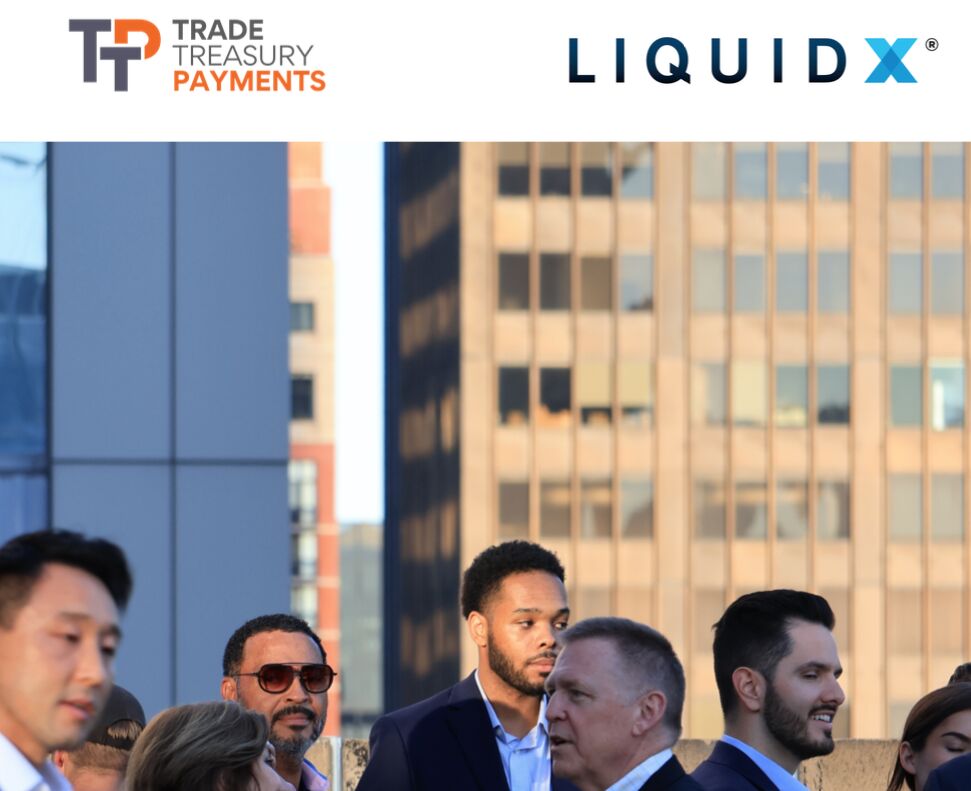
As we saw at our rooftop event in New York, in partnership with Trade Treasury Payments (TTP), from private credit to data analytics, partnerships are blurring the traditional boundaries between banks, fintechs, and investors, building a more connected, inclusive, and technology-driven market.
All of this will help every organization within the trade finance sector become more transparent, robust, and secure.
FinTechs: Sign-up to LiquidX’s White Label Program
LiquidX’s White Label Partner Program enables financial institutions and FinTech SaaS companies to launch full-turnkey, AI-enabled trade finance capabilities under their own brand without years of in-house software development.
As we’ve found from our analysis of $76.5 billion worth of transactions since 2021, white-label is the most high-growth, up 1,426% as banks and FinTechs outsource specialized trade finance functions.
Joining LiquidX’s innovative Partner Program (LPP) is far more cost and time-effective than building trade finance software in-house. That can take years and require significant investments.
Partnered with Broadridge (NYSE: BR), LiquidX provides the only complete front-to-back office trade finance solution.
Our award-winning white-label software helps banks, FinTech SaaS, and asset managers like US Bank, NORD/LB, Crédit Agricole Group (CACIB), Truist, and numerous others scale quickly, reduce costs, and handle any or every aspect of trade finance more effectively.
A recent case study demonstrates this power: an alternative credit manager with approximately $3 billion in AuM achieved a fully operational, Manager-branded platform within just 10 weeks.
Engaging in a white label partnership with LiquidX enables FinTech SaaS financial institutions to avoid costs associated with hiring new staff. This means you can focus your financial resources on your core competencies.
You can run an entire end-to-end trade finance program through our software. No need to increase headcount either, just let our software take care of everything under your brand.
Find out more, and contact us for a demo of our white-label partner program.
Share Your Views: “State of Trade Finance 2026”
Looking forward into 2026, we want to know your thoughts, views, and expert opinions on the overall state of trade finance.
Once the survey is complete, and enough responses gathered ⏤ we expect by December ⏤ we will start compiling our exclusive eBook, which we’ll launch in January 2026: “State of Trade Finance 2026: Past Learnings, Forward Thinking.”
Take 5 minutes to complete our survey, and we’ll send you the finished eBook before it’s published. Your quotes will be amplified via our PR, social media, and email marketing channels.