
Research from S&P Global has uncovered the true and staggering cost of US tariffs since the start of 2025: $1.2 trillion.
At the start of the year, before “Liberation Day”, the market might have priced in that tariffs were going to hit. But no one truly knew or could’ve predicted how bad it would be, what would happen, and who would incur the greatest costs.
Now the bill has become clear.
Who’s Paying The Cost of Tariffs?
S&P Global’s white paper is based on “information provided by some 15,000 sell-side analysts across 9,000 companies who contribute to S&P and its proprietary research indexes.”
The analysis is sobering: “Revenue expectations have risen — but earnings expectations have fallen — producing a 64-basis-point contraction in margin. If the pattern holds for firms without sell-side coverage, the cost shock would exceed $1.2 trillion in lost profit.”
“The sources of this trillion-dollar squeeze are broad. Tariffs and trade barriers act as taxes on supply chains and divert cash to governments; logistics delays and freight costs compound the effect,” author Daniel Sandberg said to CNBC.
“Collectively, these forces represent a systemic transfer of wealth from corporate profits to workers, suppliers, governments, and infrastructure investors.”
As CNBC notes, “just one-third will be borne by companies, with the rest falling on the shoulders of consumers, under conservative estimates.”
IKEA is among the firms planning to raise prices to offset the impact of a fresh round of tariffs.
Companies have also reported more than $35bn in tariff-related costs ahead of third-quarter earnings. However, many are lowering initial forecasts, according to a separate Reuters analysis of hundreds of corporate earnings statements.
$1.2tn global supply side and consumer costs increase
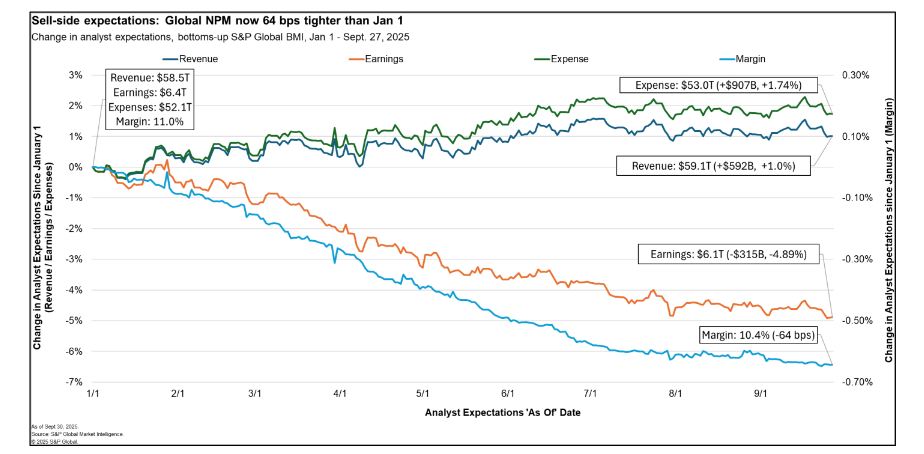
Here is a more detailed breakdown from the S&P Global Report:
- Global margin compression: A $907 billion expense shock is passed on at least two-thirds to consumers ($592bn in higher prices [for consumers]) and the remainder absorbed by companies.
- Stronger together: Margin stress spreads through supply chains. Firms with “supply chain tailwinds” (partners outperforming) were 10% less likely to see margin compression (57% vs. 67%) than firms facing headwinds.
- Closing the pressure relief valve: The de minimis rule ($800 parcel exemption) ended mid-2025, squeezing tariff-exposed sectors as shipments per container fell by half, marking a clear inflection in global trade costs.
- Tariff vs. tech tug of war: In 2025, AI lifted margins; tariffs pulled them down. Sell-side analysts rewarded balance: neutral-tone firms saw favorable margin revisions 73% of the time vs. 16% for those negative on both.
- Oh, Canada is winning 2025: Regionally, Canada (+9 bps) and China (–2 bps) held margins steady; US and Europe (–54 bps) sat mid-pack, Asia ex-China (–61 bps), MEA (–75 bps) and Latin America (–91 bps) lagged.
- The road ahead: Current belief curves imply faith in temporary shocks or successful cost mitigation, not structural decline. Margins recover from –64 bps to within 8-10 bps of Jan. 1 expectations by 2027.
The Trump administration and policymakers at the Federal Reserve hope this is simply a painful period of adjustment.
From 2026, it should mean that American businesses and consumers are better off as a result of these policies.
“In effect, 2025 locked in the hit; 2026 and 2027 will test whether the market’s optimism about re-equilibration is warranted,” the authors wrote.
“For now, consensus envisions a world where margins eventually recover to pre-tariff trajectories. Whether that faith proves justified will depend on how firms adapt through technology, cost discipline, and reshaped global value chains that have defined this cycle.”
Will tariffs negatively impact trade finance?
For several reasons, we are confident that tariffs won’t (and haven’t so far) negatively hit trade finance the way it has consumer spending.
We’ve analyzed our own data. Since 2021, and including the first 6 months of 2025 (H1), we have processed over $76.5 billion in trade finance transactions.
Within those 5.5 years of growth, 74% are banking sector client transactions, and 26% are from asset management firms.
LiquidX’s latest data reveals a compelling shift in trade finance: asset management participation has surged 48% from 2021 to 2025.
This year, it represents 35.65% of total transaction volume in ($3.55B out of $9.97B), as of July 2025. Since then, we’ve not seen any slowdown from any sector or market segment.
We also analyzed what happened between 2017 and 2023, during the previous rounds of tariffs and trade wars.
As Allianz Global Investors points out: “A closer examination of broader data suggests Mr. Trump’s tariffs may have disrupted global trade only marginally.”
As the data proves:
- Supply trade finance grew at a CAGR of 26% from 2017 to 2023 despite an increase in global protectionism and tariffs.
- Factoring finance ⏤ mainly used by small businesses and mid-market companies to raise finance against their invoices payable ⏤ still grew at a rate of 5%, despite the same headwinds and uncertainty.
This is why we’re fairly confident that even with new tariffs, trade finance won’t be dramatically impacted, and growth in this market is set to continue.
In many ways, this could prove to be an opportunity for asset managers, banks, and FinTechs wanting a white-label solution.
Disruption creates opportunities, and right now, tariffs are changing the flow and direction of trade. Corporations, SMBs, and other players in this sector would benefit from enhanced access to finance, and the buy and sell-side opportunities (distribution) that those financial vehicles create.
Share Your Views & Expertise for our eBook: “State of Trade Finance 2026”
For the first time since we launched LiquidX in 2016, we are initiating a global survey of trade finance experts. That’s right, we want to know your thoughts, views, and expert opinions on the overall state of trade finance.
Once the survey is complete, and enough responses gathered ⏤ we expect by December ⏤ we will start compiling our exclusive eBook, which we’ll launch in January 2026: “State of Trade Finance 2026: Past Learnings, Forward Thinking.”
We want to hear from as many professionals and leaders as possible across the trade finance sector, including but not limited to:
- Banks
- Asset managers
- FinTech & TradeTech SaaS
- Insurers & Re-insurers
- Law firms
- Importers and exporters
- Corporates
- Shipping companies
- Trade finance providers
- Export credit agencies
- Third-party service providers
Because we are a proud member of the Global Trade Review (GTR), and attended and were a sponsor for this year’s London event (GTR UK), this survey will also go out to 2,000 GTR members.
Take 5 minutes to complete our survey, and we’ll send you the finished eBook before it’s published. Your quotes will be amplified via our PR, social media, and email marketing channels.
What do survey participants get?
Because we’re asking for a few minutes of your time, we feel it’s only right to give you something in return.
Here is what you’ll get:
✅ An exclusive Trade Finance Industry Briefing: How to Navigate, Mitigate Risk, and Accelerate Growth Opportunities in 2025. In this, you will:
✅ Turn tariff chaos and supply chain disruptions into competitive advantages
✅ Learn how to access the $2.5 trillion untapped trade finance gap in emerging markets
✅ Discover why supply chain finance grew 26% CAGR from 2017-2023 despite global headwinds
✅ Understand how to monetize $6.9 trillion in corporate cash reserves sitting idle
✅ Master Basel III implementation without disrupting your trade finance operations
✅ Leverage AI-powered risk management while competitors still use manual processes
✅ You’ll gain access to the exclusive eBook before it’s published in January: “State of Trade Finance 2026: Past Learnings, Forward Thinking.”
And unless you choose to remain anonymous (which everyone is free to do), we will amplify your hot takes, opinions, and expertise via our PR, social media, and email marketing channels.
Join the conversation that’s defining the future of trade finance – your expertise is exactly what the industry needs to navigate unprecedented change.
Banks and asset managers: To request a demo of our trade finance distribution solutions, click here.