
As we reported earlier this year: “72% of firms [are] investing moderately to heavily in GenAI.”
“This is up from just 40% in 2024. The shift from experimentation to deployment is accelerating faster than most predicted.”
As we continue to see, Generative AI, LLMs, tools, products, and integrations are everywhere.
At BAFT GAM, Florida, in May 2026, Joon Kim, global head of trade finance and cash management platform at BNY, said: “If you do not have an AI initiative at your respective organizations, and do not have a use case, I think that’s sort of like… a red flag.”
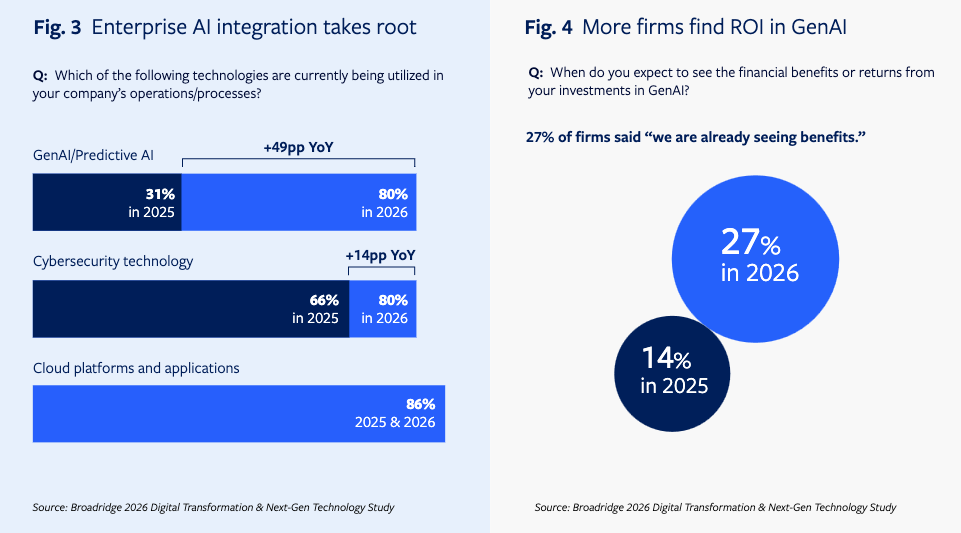
Broadridge’s recently released 2026 Digital Transformation & Next-Gen Technology Study found that 80% of financial sector companies (with an average AuM of $77bn) are using generative AI/AI tools in operations and processes.
Let’s take a closer look at what this means, and how AI adoption is playing out.
AI adoption: Is it truly accelerating in the trade finance sector?
Firstly, we should acknowledge that Broadridge’s landmark study tracks “the sentiment, reflections, and actions of more than 900 financial services technology and operations leaders from around the world across wealth management, capital markets, and asset management firms.”
It’s not specifically about the trade finance market. And it’s not specifically about AI adoption, either. It covers “what’s guiding each organization’s
transformation road map and explores their unique approaches
to AI, tokenization, cybersecurity, data strategy, and more.”
However, the views and answers contained within are broad enough to factor trade finance into account. Even if AI adoption is higher amongst certain sub-sectors, like financial services, FinTech SaaS, and private credit.
With that in mind, here are some of the most interesting findings from Broadridge’s 2026 Digital Transformation & Next-Gen Technology Study:
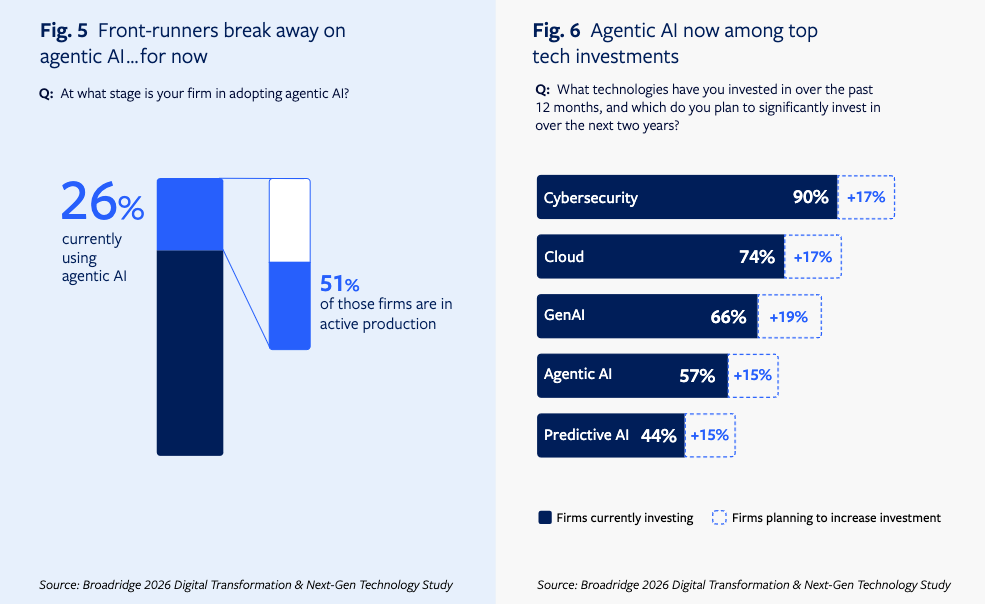
1. Even though 26% are only currently using Gen AI
2. 51% of those are in active production of new Gen AI solutions
3. Out of the top 5 tech investments amongst FIs, trade finance, and the wider financial sector:
- 44% are currently investing in predictive AI. 15% of companies are planning to increase that investment
- 57% are investing in agentic AI, with 15% increasing that
- 66% are investing in generative AI, with a further 19% increasing that
💡Download our exclusive eBook: State of Trade Finance 2026 (Looking Ahead to 2027)
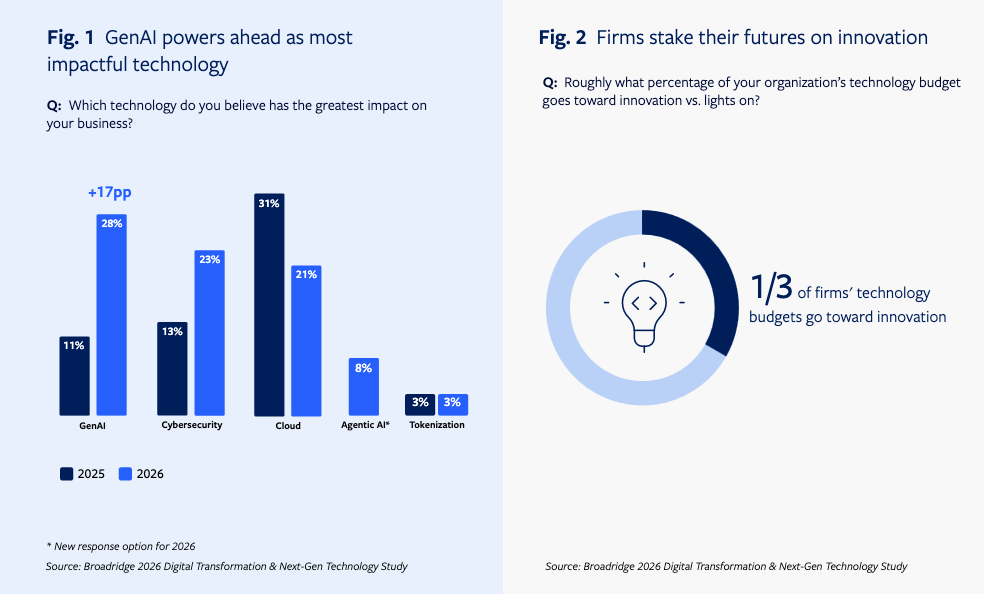
4. From the answers above, we can see that respondents are going big on AI in 2026. Up 17 points from comparable questions in 2025.
This is the biggest single issue increase, especially when we add the 8% increase in agentic AI (something that wasn’t firmly enough on anyone’s radar to be included as a stand-alone question in 2025).
5. One of the reasons for this is that 27% of firms are now reporting generating an ROI from AI. Compared to 14% in 2025 (see below).
“GenAI and the rise of the chat interface was a mass technology democratization event akin to the launch of Netscape and Internet Explorer,” explained Roger Burkhardt, Broadridge Head of AI.
“It opened everyone’s eyes to what’s possible, and now that it has so rapidly become embedded across so many aspects of the financial services workflow, we’re seeing firms move even faster into the second wave of AI adoption with agentic agents.”
“As we look ahead, the focus is really going to shift to establishing benchmarks for quantifying the benefits of these technologies as they mature.”
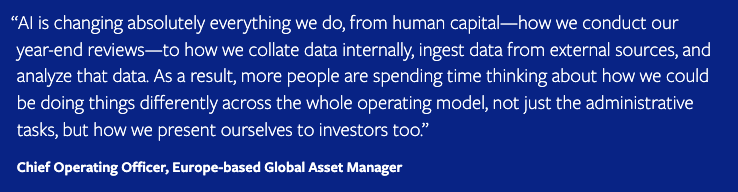
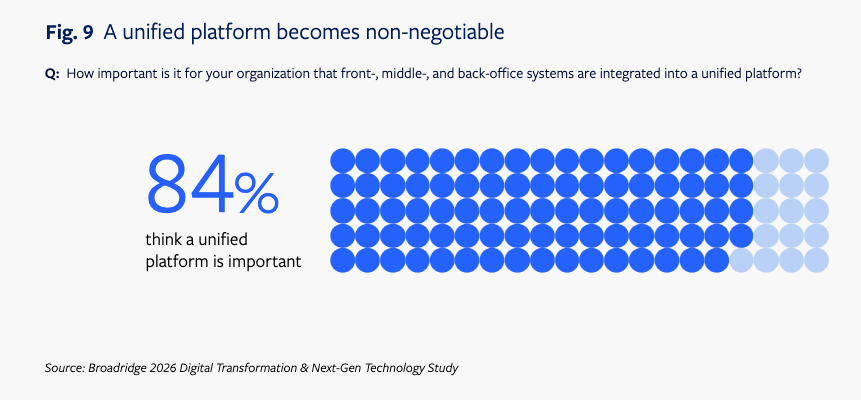
An integral part of that is making sure any AI tools are using an integrated, unified platform.
Because of the complexities of integrations with other systems, the C-suite leaders responsible don’t want to delay implementation. For this reason, integrated front-, middle-, and back-offices are essential.
Or making sure that AI systems are integrated into platforms that already have that end-to-end approach as standard.
Read more about our evolving approach to AI and machine learning (ML) in these articles:
How Can We Realize AI’s Potential To Generate Value in Trade Finance
AI & ML in Trade Finance: From Buzzword to Back Office Reality
The advantages of a platform and document-agnostic trade finance solution
How AI is Changing Trade Finance Risk Management
What does Liquidx recommend when it comes to AI adoption?
Despite the fast-paced nature of AI adoption, it still requires careful consideration. Pick the right use case.
Start small. Test it as a theory. Protect your data, your intellectual property.
To be on the safe side, we’d recommend starting small.
And that means asking smart questions, like:
- Does it make sense to implement AI for use case X?
- How have we been doing this before now?
- Will it save us time, money, resources?
- What do we gain?
Do a complete cost-benefit analysis before deciding to implement any kind of AI tool or integration. And do this on a small, manageable scale before going any further.
See what the LiquidX team has been publishing recently:
How Do Tariff Refunds Impact the Trade Finance Sector?
State of the Letters of Credit (LC) market in 2026
How Can Banks, FIs & Asset Managers Perform Due Diligence on AI Products, Tools, and Integrations?
Data Transparency and the Value of Clear Data Visibility FIs & Asset Managers Can Act On
Banks and asset managers: To request a demo of our end-to-end trade finance software solutions, click here.