

Generative AI, LLMs, tools, products, and integrations are everywhere.
At BAFT GAM, Florida, in May 2026, Joon Kim, global head of trade finance and cash management platform at BNY, said: “If you do not have an AI initiative at your respective organizations, and do not have a use case, I think that’s sort of like… a red flag.”
He may be right, and it seems that many companies in our space are already integrating AI tools in some way.
In our GTR survey, participants said that AI, automation, and digital platforms are seen as the primary drivers of transformation.
AI adoption is underway, but not universal: 50% are already using AI/ML tools.
The other 50% are not yet using AI, but many are considering it.
At LiquidX, we are taking a pragmatic approach to AI integration. An essential part of that is what our customers need. Do they need AI integrations right now, and if so, how do we ensure compliance and security?
How can banks and other trade finance operators perform due diligence on AI?
In the sector, and across all of financial services, sentiment around AI ranges from excitement to caution.
The key challenge is always about the practical and effective implementation tailored to meet client needs, and this is a different conversation for every service provider and FI.
As we’ve seen across the board, FIs are stepping up their due diligence on AI applications to ensure reliability, security, and compliance.
AI usage appears stronger among larger or digitally focused institutions.
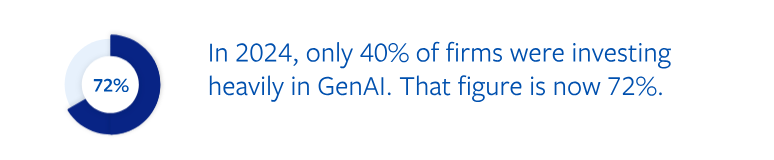
Industry leaders like Broadridge report 80% of firms globally are making moderate to large AI investments, signaling a decisive shift in the competitive landscape (our key strategic partner).
💡Download our exclusive eBook: State of Trade Finance 2026 (Looking Ahead to 2027)

As we’ve seen from our strategic partner: “Broadridge’s recently released 2026 Digital Transformation & Next-Gen Technology Study found that 26% of firms are already using agentic AI—signaling a shift toward practical applications, particularly in operations automation and customer experience.”
However, there are significant headwinds against full-scale implementation, especially in this sector:
- Product misuse and applying it the wrong way
- Governance misunderstandings
- Incorrect budget allocations
- Trying to get AI tools to do what they’re not capable of doing
- Integration with legacy systems
- Compliance failings
- Fear of AI models being trained on confidential financial information
As a result, it should come as no surprise that “Market research company Gartner predicts more than 40% of agentic AI projects will be canceled by the end of next year, often because the technology is being misapplied.”
To prevent expensive AI failures, banks, financial institutions, and asset managers considering this technology need a deployment framework that they can use.
Agentic AI deployment and testing framework for trade finance
- Start small, contained
You don’t need to go all in.
To be on the safe side, we’d recommend starting small.
And that means asking smart questions, like:
- Does it make sense to implement AI for use case X?
- How have we been doing this before now?
- Will it save us time, money, resources?
- What do we gain?
Do a complete cost-benefit analysis before deciding to implement any kind of AI tool or integration. And do this on a small, manageable scale before going any further.
- Treat AI as a (small-scale) business transformation project
Taking the above in mind, treat any AI small-scale trial like you would a business transformation project.
“Many firms initially look at agentic AI as a way to automate individual service requests, such as onboarding a new user or updating entitlements,” said Roger Burkhardt, Head of AI at Broadridge.
“But the bigger opportunity is to step back and redesign the process entirely—shifting from manual support models to intelligent self-service experiences that are faster for clients, more scalable for operations teams, and ultimately deliver a better user experience.”
Whenever possible, go beyond simple automation. Work with technology providers that can transform workflows, simplify previously complex processes, and make a genuine added-value difference to the way your trade finance program operates.

- Build around legacy systems
If you’re waiting to rebuild or modernize legacy systems in order to integrate or embed anything AI-related, you could be waiting a while.
One way around this is to use APIs, ERPs, and Model Context Protocol (MCP) to make an AI integration significantly easier.
ERP and API integration changes that math quite a bit, especially when embedding AI into an SCF process, or working capital, for example. When a lender can connect directly to a company’s live financial data and assess creditworthiness in real time, the barriers posed by documentation and processes fall away.
A small or mid-size business with two years of trading history, strong, consistent cash conversion, and a diversified receivables book can demonstrate its creditworthiness in real time rather than trying to make the case through retrospective statements.
- Want results with AI? Dedicate governance, leadership, and resources
Even if you’re doing a small-scale AI trial, it’s only going to be successful if you dedicate a certain amount of resources.
Similar to business transformation projects, they fail when no one is really responsible, there’s no governance, and not enough resources are allocated.
“Successful AI adoption starts with people, not just technology,” said Broadridge’s Burkhardt. “The firms making the most progress are identifying employees who can become early adopters and champions, giving them hands-on experience with the technology, and dedicating time for them to help rethink how the business operates.
“These leading firms are proactively defining new roles that make concrete the individual’s opportunity for career growth.”
As we’ve mentioned, AI is a topic we’ve covered a few times, and the debate will continue over the next few years.
Adoption won’t be widespread, nor fast.
Right now, we are taking a pragmatic approach, implementing the right amount of AI, with full safeguards, on a client-by-client basis, according to what individual companies need and want.
Read more about our evolving approach to AI and machine learning (ML) in these articles:
How Can We Realize AI’s Potential To Generate Value in Trade Finance
AI & ML in Trade Finance: From Buzzword to Back Office Reality
The advantages of a platform and document-agnostic trade finance solution
How AI is Changing Trade Finance Risk Management
See what the LiquidX team has been doing recently:
LiquidX at ITFA 2026: Trade Finance Evolving And Adapting
LiquidX at GTR UK 2026: Scaling UK Digital Trade And Achieving Genuine Paperless Trade Finance
Data Transparency and the Value of Clear Data Visibility FIs & Asset Managers Can Act On
Banks and asset managers: To request a demo of our end-to-end trade finance software solutions, click here.