
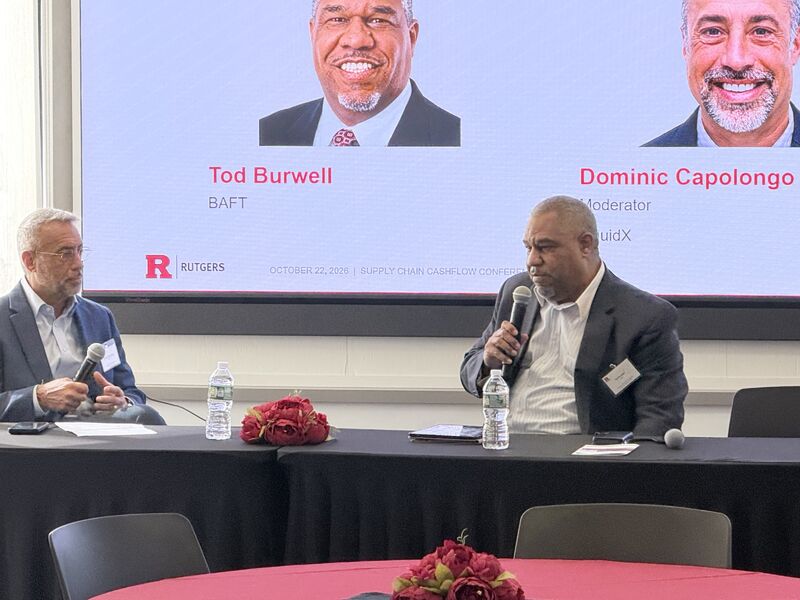
On Thursday, 22 October, our CRO, Dominic Capolongo, sat down for a keynote conversation with Tod Burwell, President & CEO of BAFT (Bankers Association for Finance and Trade), at the 2026 Supply Chain Cashflow Conference.
What is the 2026 Supply Chain Cashflow Conference?
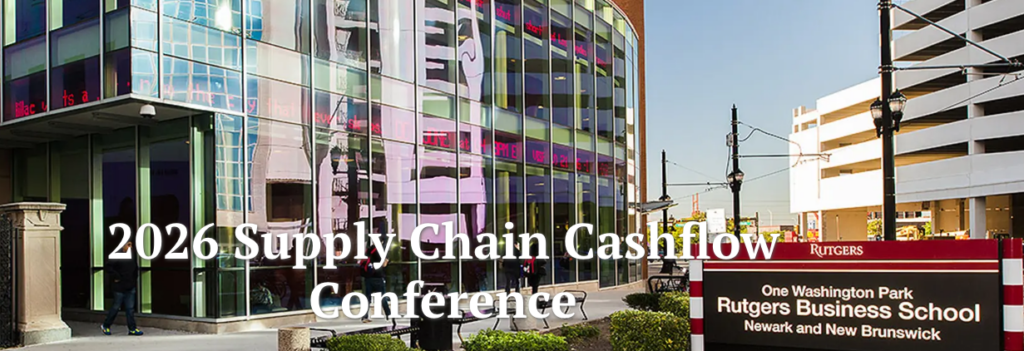
The 2026 Supply Chain Cashflow Conference at Rutgers Business School brought together finance, procurement, treasury, and supply chain professionals to explore strategies to optimize working capital, improve cash flow, and build more resilient supply chains.
The conference is organized by the Rutgers Supply Chain Cashflow Council ($CCC).
All of this is led and managed by Professor Rudolpf Leuschner, an Associate Professor in the department of Supply Chain Management and the Program Director for the online Master of Science in Supply Chain Management program at Rutgers Business School. This council brings together leaders in:
- Supply chain management
- Treasury, banking
- Fintech, and technology
The aim is to advance more strategic cash flow management across supply chains.
Its focus spans payment terms, working capital optimization, supplier financial health, alternative funding models, and evolving regulatory requirements.
By connecting financial and operational perspectives, the council promotes conversations about strengthening supplier relationships, building resilience, and creating value across the entire supply chain.
Rutgers 2026 Supply Chain Cashflow Conference Agenda
Alongside the keynote talk by BAFT CEO & President, Tod Burwell, for which our CRO, Dominic Capolongo, acted as moderator, there were the following interesting talks throughout the day:
- OPENING KEYNOTE: The Current State of the World Economy, Supply Chain Finance, and Working Capital
Dr. Alisa DiCaprio, Swift
Within that keynote, and mentioned in other talks too, were the following themes:
Disruption
- Trade, and with it trade finance, has faced growing disruption over the last decade, driven by geopolitical tensions, COVID, and shifting production hubs and reshoring.
Market shifts
- Local banks are feeling these shifts more keenly than their global counterparts.
- A key question is how markets are maintaining the fungibility of the various forms of trade financing.
Technology
- As the pace of disruption increases, so does the technology that is used, integrated, and applied in practice.
- For example, SWIFT’s worldwide study found that the main barriers to payment speed sit inside banks.
- Market needs and expectations are outpacing the speed of bank operations, and the movement of information and money is starting to shift outside bank systems.
- AI is appealing as a way to help banks assess where they need to be and what they can offer.
- Technology is advancing faster than regulators, internal risk teams, and senior operational executives can fully understand the risks.
- The turnover from the old guard to the new at banks will be important to the pace of technology adoption and implementation.
- The central challenge: how can technology be applied to manage a constantly changing landscape more effectively?

- FASHION AND APPAREL: Speed, Volatility, and Global Sourcing
Gary Schneider, Infor Nexus
Louri Amador, GIII Apparel Group
Tony Brown, Moderator
The Trade Advisory
- CAPACITY AND INFRASTRUCTURE: Financing the Infrastructure Needed to Compete
Patrick Askew, McKissack & McKissack
Mark Ferguson, Innvervation Finance Group
Eric Riddle, Moderator, SCF Strategies
- RATING AGENCIES: How Rating Agencies Evaluate Supply Chain Finance
Shripad Joshi, S&P Global Ratings
David Gonzales, Moody’s
Raina Patel, Moderator
Bank of America Debt Advisory
- INNOVATION: Next-Generation Funding: Emerging Companies and New Business Models
Dan Leva, Sequence Data
Michel Abranches, Monkey Business
Mark Ferguson, Innvervation Finance Group
- CASE STUDY: Building a World-Class Cash Culture Across the Organization
Alex Zimmerman, Pfizer
Mark Ferguson, Moderator
Innvervation Finance Group
- RESEARCH SESSION: Analyzing Payment Terms, Working Capital, and Capital Flows
Rudi Leuschner, Rutgers Business School
Dale Rogers, Arizona State University

Keynote Conversation: Reflections on the State of the Industry with BAFT CEO & President, Tod Burwell
In Dominic’s talk with Tod, they discussed the challenges and opportunities arising from the fast-changing trade finance and transaction banking industry.
They exchanged views on the growing, rapid disruptions faced by banks and non-bank funders. They also examined pressure on local banks, which must adjust quickly as supply chains shift and financing demand grows, stretching their capital capacity.
Dominic and Tod also discussed an industry facing a retirement cliff and in dire need of new young talent to support the increasing adoption of technology, including AI, across organizations.
This engaging, wide-ranging discussion unfortunately couldn’t fit into the allotted time, so it sparked a robust Q&A session and further 1-on-1 conversations over lunch.
The state of the industry is ever-shifting. It’s constantly evolving, and for many of us, it depends on our role in the sector, what our organization is doing, our respective market positions, and how we adapt to a changing environment.
💡Download our exclusive eBook: State of Trade Finance 2026 (Looking Ahead to 2027)

See what the LiquidX team has been publishing recently:
How Do Tariff Refunds Impact the Trade Finance Sector?
State of the Letters of Credit (LC) market in 2026
How Can Banks, FIs & Asset Managers Perform Due Diligence on AI Products, Tools, and Integrations?
Data Transparency and the Value of Clear Data Visibility FIs & Asset Managers Can Act On
Banks and asset managers: To request a demo of our end-to-end trade finance software solutions, click here.