

If you aren’t already using ML & AI in some way, now is the time; otherwise, you risk getting left behind by the competition.
We use the term “Machine Learning” (ML) because it better reflects what our technology offers, without getting confused with the hype surrounding AI or generative AI.
ML integration within SCF and other trade finance systems is no longer a nice-to-have; it’s mission-critical.
As our CRO, Dominic Capolongo, said in Finance Derivative:
“The key advantage lies in ML’s pattern recognition capabilities. Rather than relying on fixed rules, machine learning models can identify complex relationships between different data elements.”
“When a buyer truncates an invoice reference or applies an unexpected discount, AI can still identify the correct match by recognising patterns in the remaining data points. This capability proves invaluable when reconciling transactions affected by tariff-related adjustments or partial payments.”\
How important is ML/AI in trade finance in 2026?
Continuing with this theme, how can AI further support and enhance the supply chain finance sector? In another article, Dominic said in AI in Business:
“Sharper, more sudden fluctuations are being sparked not by the things we know are coming, but by the latest news headlines – particularly around the rapidly changing U.S. trade policy – and this unpredictability is triggering knee-jerk reactions across the market.”
“While market volatility shows no sign of settling, AI, specifically ML, does offer a solution in terms of how financial institutions handle the chaos.”

What did 2025 GTR survey participants say about AI/ML?
During Q4 2025, we surveyed hundreds of GTR members. Here are some of the key findings around AI/ML:
AI/ML adoption is no longer optional
AI, automation, and digital platforms are seen as the primary drivers of transformation.
There is a broad consensus that AI and technology will materially transform trade finance:
- Most respondents believe AI is fundamentally reshaping the sector.
- A few are neutral (“too early to say”).
- Very few disagree.
AI adoption is underway, but not universal:
- Roughly half are already using AI/ML tools.
The remainder are not yet using AI, but many are considering it. - AI usage appears stronger among larger or digitally focused institutions.
ML is an integral part of LiquidX’s InMatch: Digitization solution
At LiquidX, we’ve already incorporated machine learning (ML) in our reconciliation module, InMatch, and our end-to-end Digitization solution.
Whether you are originating or distributing, buying or selling, trade finance is an ecosystem. And every part of an ecosystem needs to communicate with one another.
The only way to do that is to ensure you’re using technology that is platform and asset-agnostic. Digitization is the only way forward, and that means using cutting-edge solutions like LiquidX that can:
- Upload any kind of document.
- Handle every type of data, and;
- Communicate (e.g., originate, distribute, buy, and sell) with systems used by other players in the industry.
Until you go digital, you can’t take advantage of automation and AI, which is where the sector is headed. At LiquidX, we are committed to an AI-powered future that supports our clients and continues to drive the industry forward.

LiquidX’s strategic partner, Broadridge investing in AI/ML tools
Our largest strategic investor and partner, Broadridge (NYSE: BR), a trusted global fintech leader with 60 years of experience, operating in 100 countries, and with over $6 billion in revenues, is also investing in AI/ML tools.
As Chris Perry, president of Broadridge, said in a DigFin podcast: “The revolutionary potential of agentic AI is parallel to the transition from older to newer programming languages, such as COBOL to Python. Financial institutions must embrace modern AI technologies to remain competitive.”
He went on to say: “As AI continues to transform the financial sector, its impact will be both profound and far-reaching. By adopting the right strategies, preparing their workforce, and ensuring trust and transparency, financial firms can harness AI’s potential to drive significant innovation and growth.”
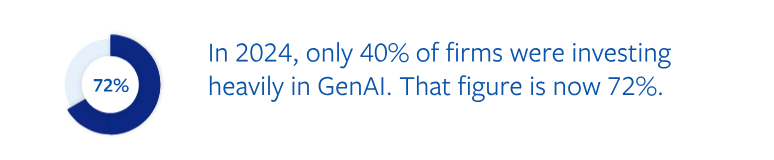
Broadridge’s “2025 Digital Transformation & Next-Gen Technology Study reveals that more firms are recognizing the need to be at the forefront of this shift, with 84% of APAC firms making moderate to large investments in AI, with the global average slightly lower at 80%.”
In other words, their survey and the results agreed with our own, that “AI is fundamentally reshaping the sector.”
💡For more information, see our article on the role of AI in risk management for trade finance.
Very soon, we will be launching our first in-depth eBook: “State of Trade Finance 2026: Past Learnings, Forward Thinking.”
Stay tuned to find out more!
Banks and asset managers: Get a demo of our comprehensive trade finance platform here