
If you aren’t already using ML & AI in 2026, now is the time.
Otherwise, you risk getting left behind by the competition.
ML integration within SCF and other trade finance systems is mission-critical.
In this article, we review five ways AI/ML is already being used in trade finance, and how you can use it to transform your trade finance programs.
AI in Trade Finance: Key Takeaways
- AI/ML adoption in trade finance is no longer optional. Roughly half of the surveyed GTR members are already using these tools, with the rest actively considering them.
- AI/ML’s pattern recognition capabilities outperform fixed rules, enabling smarter invoice matching, reconciliation, and handling of complex payment scenarios
- 5 core use cases are driving real value today:
- Risk & compliance automation
- Underwriting
- Fraud detection/KYC
- Customer service
- Predictive analytics
- AI is being embedded directly into trade finance SaaS platforms — not bolted on — making it platform- and asset-agnostic at scale
- Industry leaders like Broadridge report 80% of firms globally are making moderate to large AI investments, signaling a decisive shift in the competitive landscape.
We use the term “Machine Learning” (ML) more often in this article because it better reflects what our technology offers.
As our CRO, Dominic Capolongo, said in Finance Derivative:
“The key advantage lies in ML’s pattern recognition capabilities. Rather than relying on fixed rules, machine learning models can identify complex relationships between different data elements.”
“When a buyer truncates an invoice reference or applies an unexpected discount, AI can still identify the correct match by recognizing patterns in the remaining data points. This capability proves invaluable when reconciling transactions affected by tariff-related adjustments or partial payments.”
Is AI’s potential clouding its practical implications?
Not a day goes by without AI being in the news.
Either it’s a new deal being done. Usually worth billions of dollars between a couple of the big players in the AI space.
Or a new Generative AI or Large Language Model (LLM) is being released, trained, shut down, or doing something unexpected.
Jobs are being lost because of AI. Goldman Sachs estimates between 2.5% and 7% of the US workforce. Potentially more.
Potential is a word that does a lot of heavy lifting in AI. A lot of jobs seem to be getting cut in corporate America because of AI’s potential, not its current capabilities.
At the same time, PwC is calling AI the “$15.7 trillion game changer.”
PwC predicts that AI could “Contribute up to $15.7 trillion to the global economy in 2030, more than the current output of China and India combined.”
“Of this, $6.6 trillion is likely to come from increased productivity and $9.1 trillion is likely to come from consumption-side effects.”
This enormous potential is one of the reasons that OpenAI is worth $852 billion, and is looking at an IPO in the future.
On a technical level, AI’s potential is huge. There’s no denying that.
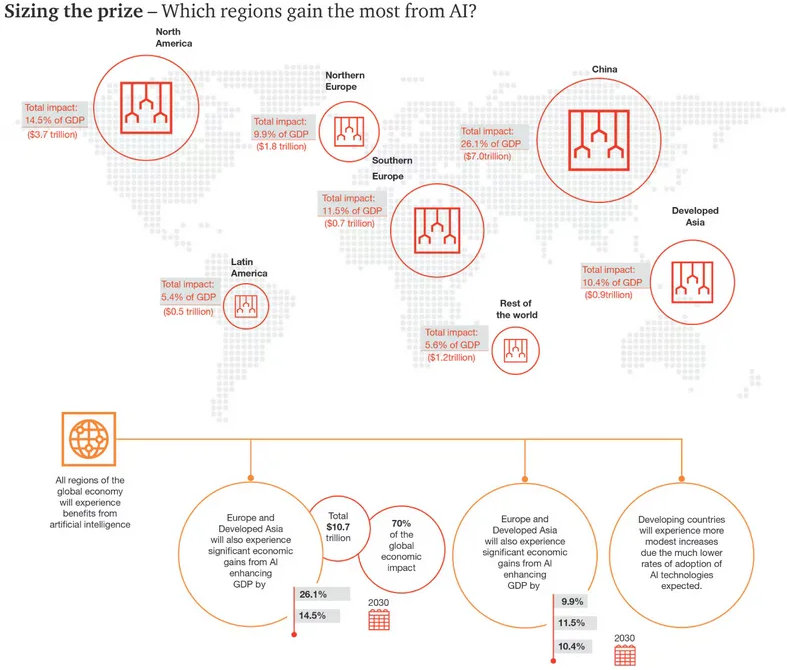
Above: PwC predicts which regions will experience the greatest gains from AI, with North America potentially gaining 14.5% of GDP, China 26.1%, and Northern Europe 9.9%.
However, the challenge with AI is realizing that potential in practice, and for us in the trade finance sector, it’s the practical, safe implementation we need to concern ourselves with.
During Q4 2025, we surveyed hundreds of GTR members. Naturally, AI is a hot topic, so we gauged the views of other revenue and technology leaders in the sector.
What did GTR survey participants say about AI/ML?
Here are some of the key findings around AI/ML:
AI/ML adoption is no longer optional
AI, automation, and digital platforms are seen as the primary drivers of transformation.
There is a broad consensus that AI and technology will materially transform trade finance:
- Most respondents believe AI is fundamentally reshaping the sector.
- A few are neutral (“too early to say”).
- Very few disagree.
AI adoption is underway, but not universal:
- Roughly half are already using AI/ML tools.
The remainder are not yet using AI, but many are considering it. - AI usage appears stronger among larger or digitally focused institutions.
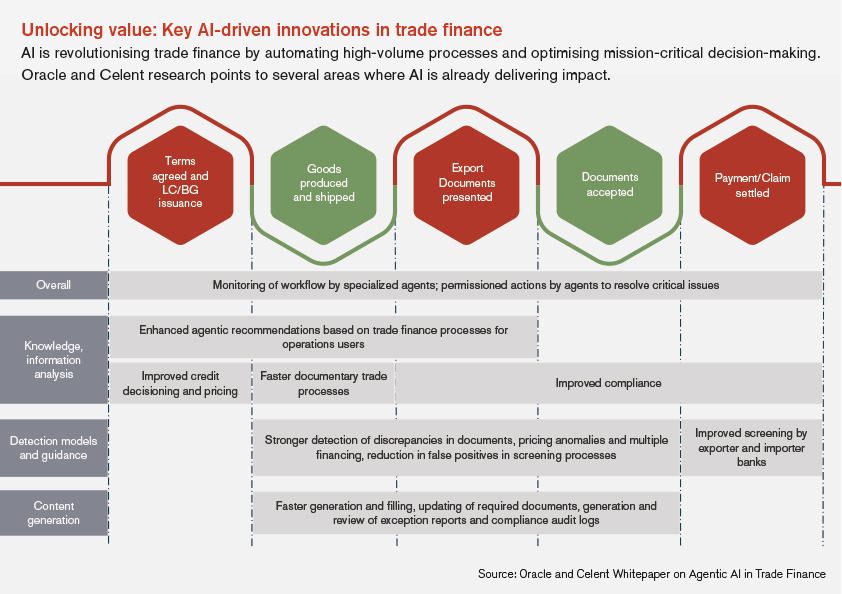
5 ways AI can unlock value in the trade finance sector
When we talk about AI in the trade finance sector, we aren’t referring to using OpenAI’s ChatGPT, Google’s Gemini, or Anthropic’s Claude to process client data.
No, we are talking about AI and ML being embedded into trade finance SaaS applications. In practice, this can be done in one of two ways:
- Customized applications for specific clients that need AI and can successfully achieve synergetic compliance within a trade finance system.
- Trade finance software that includes AI or ML built into what every client uses.
It should come as no surprise that AI and AI-related applications, like Machine Learning (ML) and Natural Language Processing (NLP), have been playing a role in this sector for several years. Long before ChatGPT appeared.
With that in mind, here are the ways that AI/ML is already unlocking practical value in trade finance:
1. Risk management and compliance in trade finance
Risk management and compliance are essential to trade finance.
If you can automate as much of this as possible, it frees up resources for other, more profitable, or at least revenue-focused tasks.
That’s where and how AI and automation software come into the picture. Taking manual tasks ⏤ like uploading invoices or assessing contracts for counterparty risk ⏤ and automating them.
LiquidX has an end-to-end digitization solution widely used by banks, asset managers, and other players in the trade finance space.
When you automate manual processes and digitize transactions across systems, you get better visibility and cash forecasting.
With LiquidX Digitize, you can turn any trade finance document into self-executing smart contracts that deliver upstream and downstream visibility to optimize the working capital lifecycle.
2. AI trade finance risk and insurance underwriting
As we’ve covered in previous articles, one of the advantages of trade finance is the low risk of these financial instruments, which makes them attractive to banks and asset managers.
Low default risk for trade finance distribution products
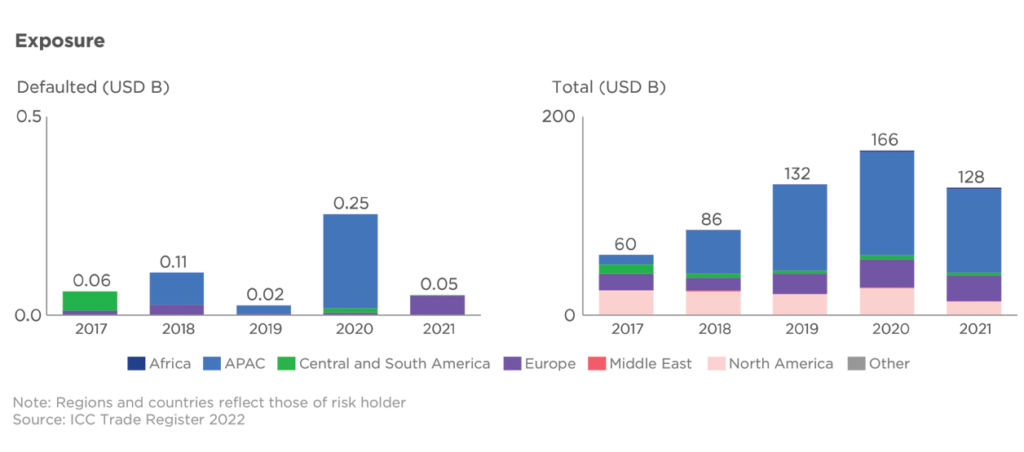
Low-risk and very low default rates for the following popular trade finance distribution financial instruments: accounts receivable (AR) and supply chain finance (SCF) (source)
However, low risk is not zero risk. Therefore, underwriting is still an important part of the process.
Various AI models, such as Decision Trees, Random Forests, Gradient Boosting Machines (GBMs), and other Neural Networks, can be used for underwriting in trade finance. Back-office solutions can integrate AI into underwriting to improve decision-making efficiency and reduce the risk of human error.
3. Fraud detection, prevention, and KYC
According to EY, “An estimated $1 trillion of financial crime proceeds flow through the $9.1 trillion industry’s trade channels each year.”
As a result, KYC and AML are essential to any trade finance transaction.
Consequently, parties to trade finance transactions (buyers, sellers, and funders) need to conduct the usual fraud-detection checks and safeguards.
As part of risk management, automating and using AI makes this process easier, more efficient, faster, and less prone to human error.
4. Improved customer service for banks, asset managers, and SME financing organizations
Most banks, asset management firms, or providers in the trade finance space will have some form of customer service solution.
In almost every case, AI is already an embedded and normal part of customer service. The aim of using AI is to:
- Reduce customer service costs;
- Give customers answers and information more quickly, and
- Support customers more effectively 24/7, which is often too expensive with human agents.
Martin Moeller, Head of AI & GenAI for financial services, EMEA, at Microsoft, told Reuters: “Generative AI will reshape the competitive landscape.”
Moeller cites Klarna, a Swedish fintech company, which is now using OpenAI and other AI tools to handle the work of 700 customer service employees.
Talking about wealth management, UBS CEO Sergio Ermotti recently said: “Banks that have so far been barely active in wealth management could enter the business with the help of AI without having to invest much in customer advisors.”
The same can apply to trade finance. AI should make it easier to provide enhanced customer service at scale without the extra cost of increasing headcount.

5. Predictive analytics and forecasting in trade finance risk models
Considering the current state of the world, we need all of the help we can to understand, analyze, and de-risk financial models.
Banks and asset managers need a way to forecast demand, assess who’d be a good buyer for trade finance assets at a spread, and reduce counterparty risk and overexposure to any one organization, sector, or transaction type.
For example, if you are holding $500M in a $1bn portfolio of short-term consumer goods transactions, it might be worth diversifying. AI can help make this easier by providing automated alerts and trigger points for rebalancing.
Next Gen Data Capabilities: LiquidX TradeHub
TradeHub allows customers to aggregate their data across various investment programs and platforms, regardless of the origination source.
Create holistic views of your exposures relative to your unique risk constraints. The automation of reconciliation processes allows our engine to digitally match invoices, remittance advice, and payments.
TradeHub is fully configurable to your requirements, with bespoke cross-sections for your business. Data is accessible to stakeholders across your institution to enable real-time, data-driven decisions.
You can set up customized feeds and reports for unprecedented insights into your portfolios.
How can AI be embedded in trade finance SaaS applications?
In a GTR article, Lokesh Gupta, VP, Product Management & Development, Corporate Banking & Integrated Quality at Oracle, said that: “Banks that have embraced cloud-native AI embedded solutions demonstrate improved agility, operational resilience and the capability to respond to evolving market demand.”
“Institutions also need to establish baseline ethical frameworks, such as the OECD AI principles for responsible AI – supported by human oversight – to help protect fundamental rights, including strong data governance, safety and security, intellectual property considerations, and potential impacts on competition.”
That’s the main challenge, and that’s why we’ve invested so much time and effort into integrating ML safely, and in a way that’s compliant with trade finance systems to ensure clients can actually benefit from this technology at scale.
ML is an integral part of LiquidX’s InMatch: Digitization solution
At LiquidX, we’ve already incorporated machine learning (ML) in our reconciliation module, InMatch, and our end-to-end Digitization solution.
Whether you are originating or distributing, buying or selling, trade finance is an ecosystem. And every part of an ecosystem needs to communicate with one another.
The only way to do that is to ensure you’re using technology that is platform and asset-agnostic. Digitization is the only way forward, and that means using cutting-edge solutions like LiquidX that can:
- Upload any kind of document.
- Handle every type of data, and
- Communicate (e.g., originate, distribute, buy, and sell) with systems used by other players in the industry.
At LiquidX, we are committed to an AI-powered future that supports our clients and continues to drive the industry forward.
LiquidX’s strategic partner, Broadridge investing in AI/ML tools
Our largest strategic investor and partner, Broadridge (NYSE: BR), a trusted global fintech leader with 60 years of experience, operating in 100 countries, and with over $6 billion in revenues, is also investing in AI/ML tools.
As Chris Perry, president of Broadridge, said in a DigFin podcast: “The revolutionary potential of agentic AI is parallel to the transition from older to newer programming languages, such as COBOL to Python. Financial institutions must embrace modern AI technologies to remain competitive.”
He went on to say: “As AI continues to transform the financial sector, its impact will be both profound and far-reaching. By adopting the right strategies, preparing their workforce, and ensuring trust and transparency, financial firms can harness AI’s potential to drive significant innovation and growth.”
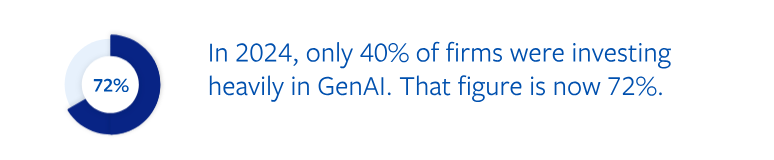
Broadridge’s “2025 Digital Transformation & Next-Gen Technology Study reveals that more firms are recognizing the need to be at the forefront of this shift, with 84% of APAC firms making moderate to large investments in AI, with the global average slightly lower at 80%.”
In other words, their survey and the results agreed with our own, that “AI is fundamentally reshaping the sector.”
Are you ready to integrate ML and AI into your trade finance programs?
Banks and asset managers: Get a demo of our comprehensive trade finance platform here